




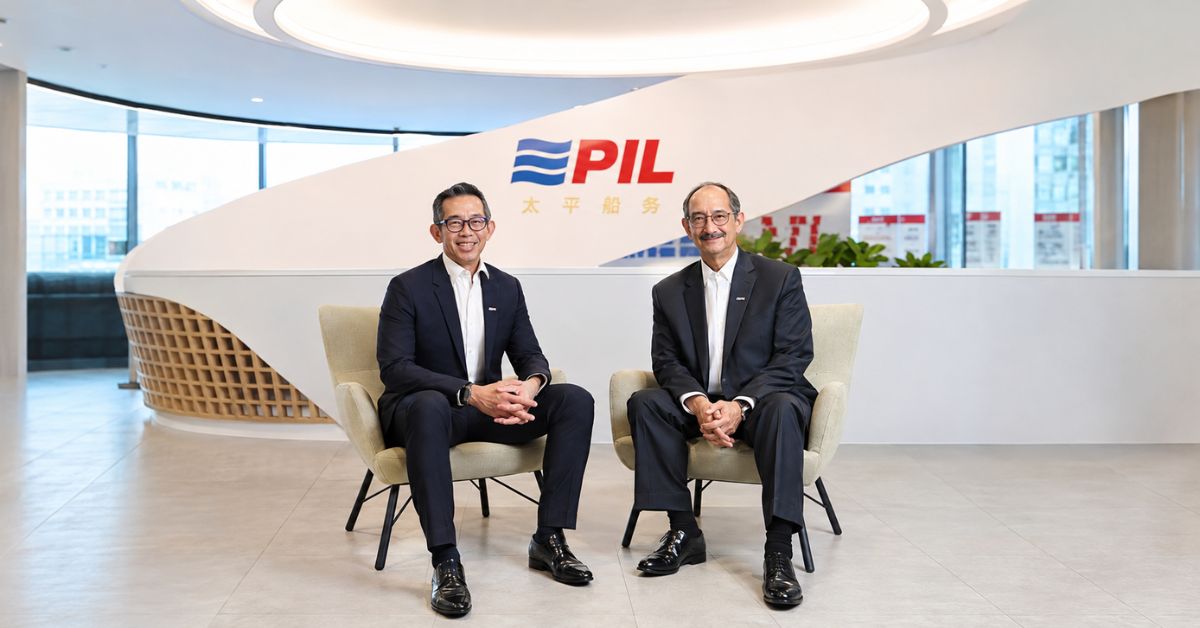

Singapore-based Pacific International Lines (PIL) has appointed Wan Chee Foong as Deputy Chief Executive Officer, with plans for him to succeed Lars Kastrup as Chief Executive Officer in April 2027. The succession, announced on 22 September, provides for a six-month handover to maintain continuity across the container shipping group’s operations.
Wan’s appointment took effect on 5 October 2026. Kastrup will continue leading the company during the transition before becoming an adviser to the board. The selection followed a board-led assessment of internal and external candidates.
How will PIL manage the leadership transition?
Wan will progressively take responsibility for commercial, operational and strategic matters, working alongside Kastrup and senior management.
He joins from Temasek, where he served as Managing Director, Corporate Strategy. His career spans nearly three decades across transport, logistics, investment and strategy, beginning at Singapore Airlines.
Kastrup joined PIL as Senior Adviser in July 2020, became Co-President and Executive Director in March 2021, and assumed the CEO position in July 2022.
The transition follows stronger financial results. PIL reported net profit after tax of US$1.04 billion on revenue of US$4.27 billion for the 2025 financial year.
What experience does Wan bring from ports and logistics?
Wan previously led PSA International’s Middle East and South Asia region while overseeing group business development. He subsequently became CEO of PSA BDP on 3 October 2023, taking charge of the port group’s global cargo solutions business.
PSA’s announcement of that appointment credited him with helping shape investments across ports and logistics, including its acquisition of BDP International. PSA acquired BDP in April 2022 and renamed the business PSA BDP in April 2023.
Headquartered in Philadelphia, PSA BDP provides services spanning ocean, air, rail and road transport, freight forwarding, customs clearance, warehousing and supply chain management. Wan’s leadership responsibilities therefore extended across both port operations and the inland services connecting manufacturers and cargo owners with shipping networks.
Fleet modernisation forms a key operational backdrop
PIL’s leadership change comes during a substantial vessel renewal programme.
On 23 June 2026, the company named Kota Elok and Kota Elan at Hudong-Zhonghua Shipyard in Shanghai. Each has capacity for 13,000 twenty-foot equivalent units (TEUs), and the pair are the first vessels in a series of 13 ships of that size.
At the naming ceremony, PIL identified the Asia–South America trade as their intended deployment, linking the investment to capacity requirements and operating efficiency on that corridor.
Both vessels can operate on liquefied natural gas (LNG) and low-sulphur fuel oil. Their designs include optimised hull forms, energy-saving systems and hull coatings intended to reduce fuel consumption.
Digital equipment supports operational monitoring and automation, while Kota Elok also features a bow windshield designed to reduce aerodynamic resistance. PIL has positioned these investments within its fleet modernisation programme and its stated ambition to reach net-zero emissions by 2050.
An international network with established Indian connections
Founded in Singapore in 1967, PIL operates around 100 container vessels and serves customers in more than 90 countries. Its business covers dry, refrigerated, breakbulk and special cargo, alongside logistics and container manufacturing activities.
The carrier’s network spans Asia, Africa, the Middle East, Latin America, Oceania and the Pacific Islands.
For Indian customers, PIL combines direct services with feeder connections and transhipment through Singapore and Port Klang. The company has served the Indian subcontinent for more than four decades, connecting regional cargo with its wider international network.
These liner and inland connections form part of the business Wan will lead as PIL approaches its 60th anniversary in 2027.
 Join our WhatsApp channel for more updates:
 Subscribe to our YouTube channel for more updates:




