



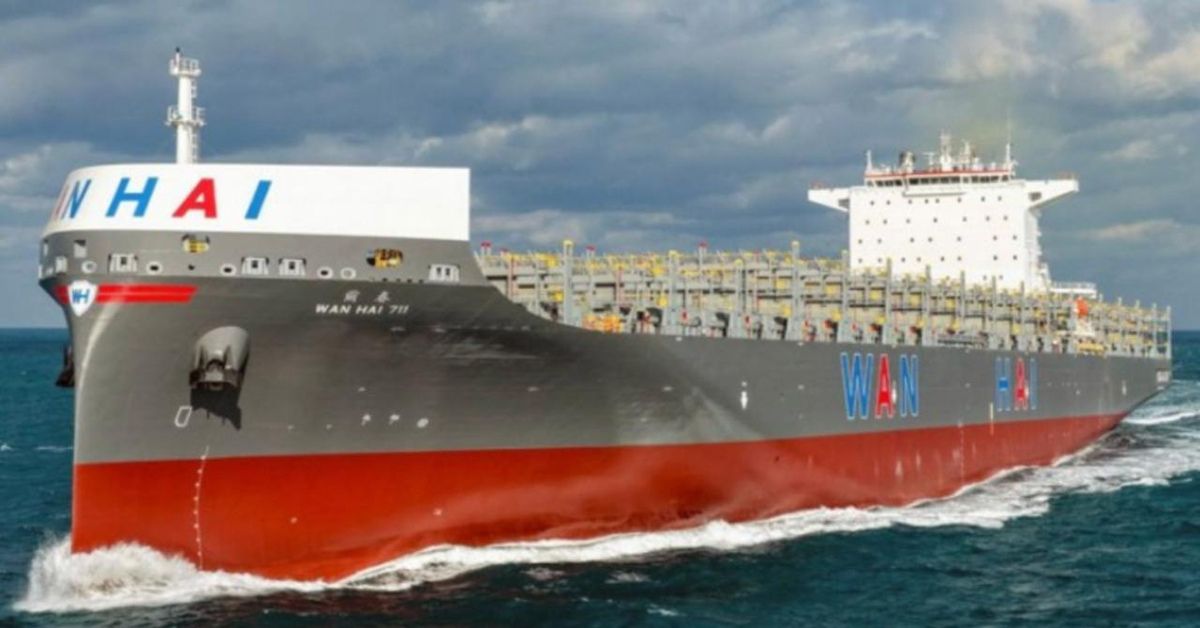

Taiwanese container shipping company Wan Hai Lines has placed orders for eight new containerships at Shanghai Waigaoqiao Shipbuilding, in a deal worth up to $980 million, expanding the carrier’s dual-fuel newbuild fleet significantly.
What is the composition of this newbuild order?
The order comprises one 9,200 TEU vessel, configured to be methanol dual-fuel ready, and seven 11,000 TEU vessels, which will support both methanol and LNG dual-fuel operations. The 9,200 TEU unit is priced between $102 million and $112 million, while each of the seven larger vessels carries a price tag of $118 million to $124 million.
How much is Wan Hai investing in total, and does the price include extras?
Across the two contracts, Wan Hai’s total expenditure will range between $928 million and $980 million, with the prices including equipment upgrades on top of the base vessel cost.
How does this fit into Wan Hai’s broader relationship with Shanghai Waigaoqiao?
The latest orders extend Wan Hai’s growing partnership with the CSSC-affiliated yard. In March 2026, the carrier had already booked two 9,200 TEU methanol-ready ships at the same shipyard for a combined $204 million to $224 million, as part of a six-ship ordering round that also included four 6,000 TEU LNG dual-fuel newbuilds contracted at Huangpu Wenchong Shipbuilding.
What does this mean for Wan Hai’s overall newbuilding backlog?
The latest contracts bring Wan Hai’s total newbuilding backlog to 50 boxships, with a combined capacity of nearly 500,000 TEU, reflecting a sustained fleet renewal programme centred on dual-fuel and methanol-ready vessel designs. Wan Hai is currently ranked the world’s 11th-largest liner operator, with an existing fleet of 124 vessels totalling 624,354 TEU.
What does this signal about the broader container shipping industry’s fuel strategy?
Wan Hai’s continued investment in methanol- and LNG-capable newbuilds reflects the wider container shipping sector’s push toward dual-fuel flexibility, as carriers position their fleets to meet tightening emissions regulations while retaining the operational flexibility to switch between conventional and alternative fuels as bunkering infrastructure develops globally.
 Join our WhatsApp channel for more updates:
 Subscribe to our YouTube channel for more updates: