


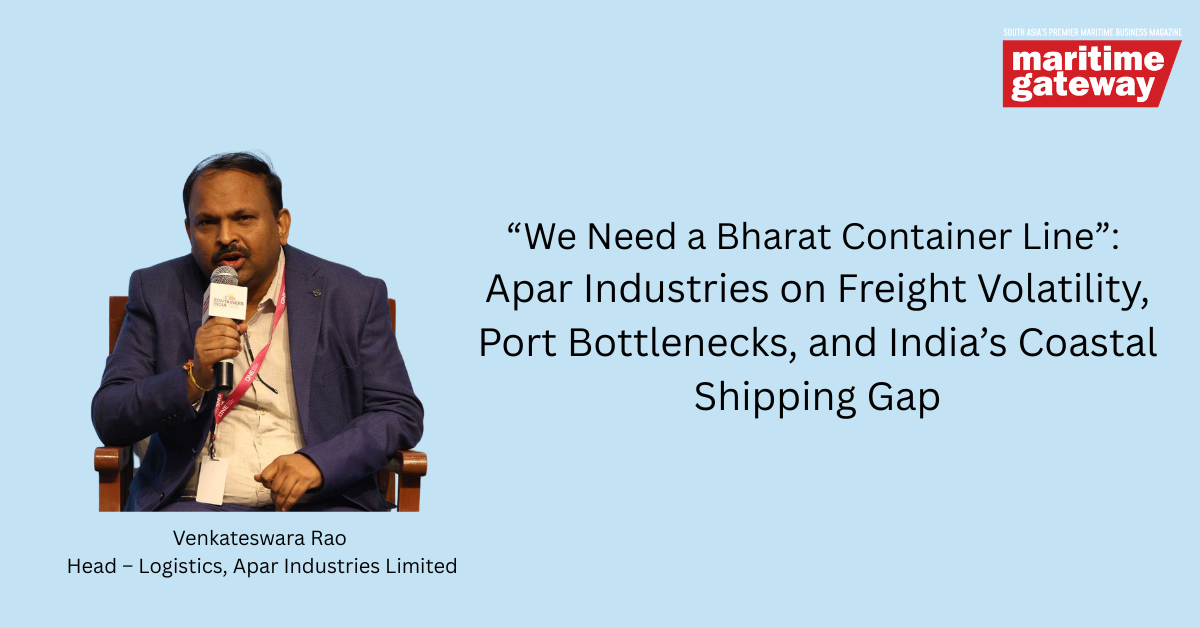

Apar Industries, an energy conglomerate with a product portfolio spanning conductors, cables, specialty oils, polymers and lubricants, ships close to 2,000 TEUs a month out of India to 143 countries. In an interview with Ramprasad Ravi, Venkateswara Rao, speaks about the company’s export footprint, the volatility of ocean freight rates, congestion at Nhava Sheva, and why he believes India needs a state-backed shipping line to counter the pricing power of global carriers.
Apar operates across a wide product range — conductors, cables, specialty oils, polymers, lubricants. Could you give us a sense of your current export-import volumes and the trade lanes and geographies that matter most to you?
Apar is an energy conglomerate with a turnover of roughly $3 billion and a presence in 143 countries. Our overall mix is about 40% exports and 60% domestic sales, and we are present across all major geographies worldwide. The US is our single largest export market, accounting for around 40% of our export volumes.
In terms of volumes, we ship roughly 1,500 containers a month, approximately 50% twenty-foot and 50% forty-foot equivalents, which works out to around 2,000 TEUs a month in exports. Of that, around 800 containers go to the US.
Which ports do you predominantly use?
We route about 80% of our shipments through JNPT and the remaining 20% through Nhava Sheva.
What are the most difficult challenges you face in your supply chain and logistics, both inbound and outbound?
The single biggest challenge on the outbound side is ocean freight rates. Freight costs need to be predictable for us to do business, but ocean freight is not in anyone’s hands, not even a Walmart or a Reliance. We are all at the mercy of the European shipping lines, mainly Maersk, MSC, Hapag-Lloyd and CMA CGM.
Rates move drastically. We have seen them go from $100 to $7,000. Take the Middle East, we used to pay $200 to Jebel Ali; today it is $5,000. That is a 25-fold increase, and no business has the margins to absorb that.
People take advantage of crises, the Strait of Hormuz situation, the Russia-Ukraine war, the conflict in the Middle East. Whenever there is uncertainty, shipping lines make money and the shipper, and ultimately the consumer, pays for it. Costs rise and we lose the ability to plan.
I cannot tell you today what my ocean freight budget will be from April to March. Every company builds an annual budget, but we cannot give firm freight commitments to our customers. European freight rates have gone up three-fold, Latin American rates five-fold. How do you run a business when five times your margin is going into logistics?
What India needs is one strong Indian shipping line, a Bharat Container Line, properly funded. Give it ₹20,000 crore, have it acquire 50-60 ships and 15,000-20,000 containers, and it would bring a level playing field. Once a credible domestic alternative exists, every shipping line would be forced to compete on price. Right now, we operate entirely at the whims of the European lines.
Israel has ZIM, China has COSCO. The Israeli government and defence ministry refused to allow ZIM to be privatised or sold to Hapag-Lloyd, because they understand the strategic value of a national shipping line. India has no equivalent. There is talk of a Bharat Container Line, but the government has not been serious about it.
Beyond freight rates, do you face challenges such as container non-availability or port congestion?
Yes, delays at every level. For the past three to four months, since March, we have faced serious challenges at Nhava Sheva. The port was declared a transshipment port for political reasons, without any thought given to what that would mean for Indian shippers. Trucks now wait for hours, sometimes days, to enter JNPT. That means detention costs for trucks and containers, damage charges, and an inability to meet the timelines we have promised customers.
There are also blank sailings to contend with. MSC cancelled 12 vessels on its US service and redeployed them to China, just like that. There was no demand spike out of India, but because China sneezed, we caught the cold. If Indian trade is going to be dictated by decisions made in China, how is India supposed to develop?
What has been your experience with the Dedicated Freight Corridor?
The DFC is a welcome development. Transit that used to take five to six days now arrives within 24 to 30 hours for time-bound shipments, and double-decker freight trains have also started running, another positive step.
That said, the DFC leg towards JNPT still needs development. There are teething issues, some lines are occupied, and there isn’t yet seamless movement from JNPT into North India. Once that is resolved, volumes will grow further.
How much do you rely on road logistics?
For our domestic business, we predominantly use road, though we are gradually moving towards a multimodal model: first mile by road, middle mile by rail, last mile by road. Road still dominates, and credit for that goes to the work done by Minister Nitin Gadkari and the NHAI.
Road remains faster than rail. By road, we average 400 km a day; by rail, it’s 150-200 km a day. Mumbai to Kolkata takes 15 days by rail against five days by road, and no customer will wait 15 days for cargo. Rail is only competitive with road on the Dedicated Freight Corridor.
Ideally, what logistics infrastructure would you like to see to improve efficiency and ease of movement?
All modes, road, rail and coastal shipping, need to be accessible and efficient. Coastal shipping is where India lags furthest behind. In Europe, 30-35% of cargo movement happens via coastal shipping; in India, it’s barely 1-2%.
Coastal shipping is less carbon-intensive and more cost- and time-efficient. We have eight plants near Silvasa, with Hazira as the nearest port, and we would like to move cargo from Hazira to the rest of the country by coastal shipping. But apart from DP World, which runs one vessel every 10 days to South India, there are no real options.
India has the Shipping Corporation of India, but it doesn’t run the services we need. The government should incentivise industry to use coastal shipping and encourage shipping companies to establish services along India’s coastal routes. Our coastline is a massive untapped opportunity, it could be linked with inland waterways, developed through dedicated zones, and built into a seamless network connecting the west coast to the east.
What are Apar’s expansion plans and expected cargo growth in the coming years?
Apar is a fast-growing company. We have been growing at 20-25% a year and plan to maintain that trajectory, bringing new manufacturing capacity online every year and expanding existing plant capacities.
We are market leaders across our segments, the number one conductor company in the world, the third-largest specialty oils company globally, and India’s largest exporter of cables. We expect to keep growing on that footing year after year.
 Join our WhatsApp channel for more updates:
 Subscribe to our YouTube channel for more updates: