




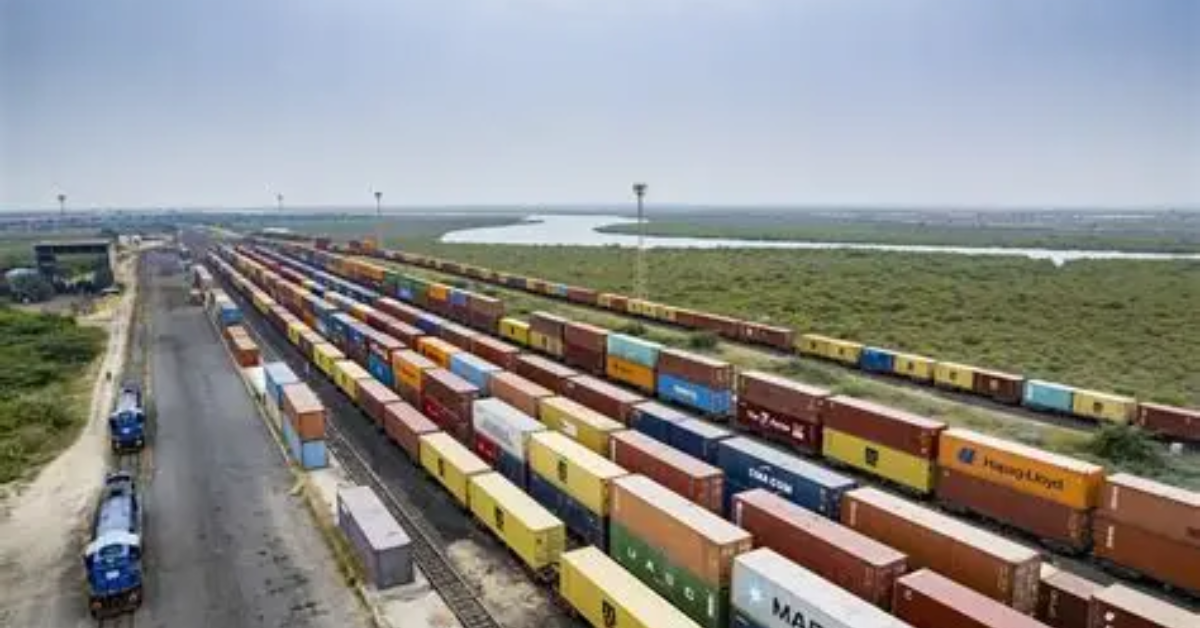

India’s Western Dedicated Freight Corridor has now achieved full commissioning end-to-end, running from Dadri in Uttar Pradesh all the way to Jawaharlal Nehru Port in Maharashtra — a transformative infrastructure milestone that has been more than a decade in the making and will fundamentally reshape the logistics economics of moving cargo between India’s northern and western industrial heartland and its primary international container gateway.
The full commissioning follows the successful trial run on the final 102-kilometre JNPT–New Saphale section that was announced on April 1, confirming operational readiness across the entire corridor. With all sections now active, the Western DFC enables freight trains to travel at significantly higher speeds on tracks dedicated exclusively to cargo — eliminating the longstanding conflict between passenger and freight train scheduling that has historically constrained Indian freight rail performance. The corridor can handle 25-tonne axle load trains of up to 1.5 kilometres length, roughly double the capacity of conventional mixed-use rail, enabling far larger cargo volumes per train movement.
The JNPA Connection: The Most Critical Last Mile
The JNPA connection — which allows direct rail freight movement between India’s largest container port and the DFC network without traversing Mumbai’s congested suburban rail system — is arguably the most commercially significant section of the entire project. Before this connection, cargo moving between JNPA and inland destinations faced the bottleneck of Mumbai’s passenger-dominated rail corridors, with freight trains waiting hours for available slots. Now, containers can depart JNPA directly onto dedicated freight tracks, connecting to the national DFC spine and reaching destinations in Delhi, Rajasthan, Gujarat, and UP at transit times competitive with road transport, at substantially lower cost per tonne-kilometre and with far lower carbon emissions.
Cashless Tolls from April 10: Road Logistics Impact
India’s road logistics sector faces an operational shift from April 10, when the Ministry of Road Transport and Highways mandates the complete elimination of cash transactions at toll plazas. All toll payments must be made via FASTag or UPI — vehicles without a valid FASTag will still pass but pay 1.25 times the standard toll via UPI. The Ministry has also introduced Exempted FASTags and annual passes (₹3,075 for private cars, up to 200 crossings) for government vehicles and eligible entities. For commercial trucking operators — the backbone of India’s domestic logistics — the full cashless transition reduces queuing and friction at toll plazas, improving average truck speeds and turnaround times across national highway networks.
IIFCL: Doubling InvIT Exposure to ₹6,000 Crore
On the infrastructure financing side, India Infrastructure Finance Company Limited has announced a plan to double its InvIT exposure from the current ₹3,000 crore across nine trusts to ₹6,000 crore by March 2027. Managing Director Rohit Rishi described the expansion as part of IIFCL’s strategy to diversify investments and strengthen support for India’s infrastructure sector, with InvITs providing a vehicle to channel long-term institutional capital into operational infrastructure assets including roads, ports, transmission lines, and logistics parks. The IIFCL commitment provides a significant pipeline of capital for InvIT sponsors looking to monetise operational infrastructure assets — a mechanism that could be particularly relevant for port and logistics park infrastructure as the sector continues to attract private capital at scale.
 Join our WhatsApp channel for more updates:
 Subscribe to our YouTube channel for more updates: