




AI Is Not an IT Project
Chakib Abi-Saab has spent much of his career at the intersection of technology strategy and industrial transformation. As Chief Technology and Innovation Officer at Lloyd’s Register, he sees maritime’s AI challenge not as a technology gap but as a mindset problem. In a wide-ranging conversation at Singapore Maritime Week, he speaks to Maritime Gateway about digital maturity, data orchestration, seafarer adoption, and the critical question now facing every shipowner.
There is a lot of talk about AI in maritime, but you seem to think the industry is still fundamentally misreading what it means. Where does the misunderstanding lie?
The biggest misunderstanding is that organisations still treat AI as an IT project. It is not. It is a core strategy decision, a transformation that will either enable you to compete and survive, or see you consumed by others who become more efficient by adopting better technologies. I do not think it is optional. I think it is vital. And I am genuinely concerned that many organisations have not yet grasped the gravity of not acting.
Then comes the harder question: what does it actually take to create an environment that enables AI? Because it is not as simple as having some data, implementing an algorithm, and arriving at a fantastic outcome. You first need to know what you are trying to achieve. What data will you require? What will it take to obtain that data, clean it, and keep it clean? Are the algorithms you create trustworthy enough to make decisions on? What level of human oversight do you want in the loop? And if you move to practical applications in shipping itself, who is responsible when an AI-recommended decision causes harm?
We are in a situation where AI-enabled decision making will continue to accelerate, but regulation is lagging far behind the real challenges in the industry. That gap makes companies afraid to adopt more aggressively. So the obstacle is not always the technology failing to exist. Often it is the industry not being ready.
I always use aviation as an analogy. Aircraft can now effectively fly themselves. There is no fundamental technological reason shipping cannot reach a similar frontier. The barrier is an industry mindset challenge, not an engineering one.
Where would you place the maritime industry on the AI adoption learning curve?
Fragmented. Some organisations are investing significantly; many others are far behind. Through our advisory services, assessing the digital maturity of clients across the industry, we have found that the majority of maritime companies are, frankly, at an early stage. They have dashboards, some level of reporting and analytics, but they sit on top of very poor data management, very high levels of manual intervention, and a fundamental lack of clarity about who owns the end-to-end process that is being automated.
There is another pattern we see frequently: organisations trying to use AI to solve problems that cannot be solved by AI, because those problems were created by bad processes in the first place. If you automate a broken process, you get broken results faster. That is not a technology failure; it is a process failure. Unless an organisation recognises that digital transformation is a corporate-level effort requiring a genuine change in the operational model, scalable AI will remain out of reach.
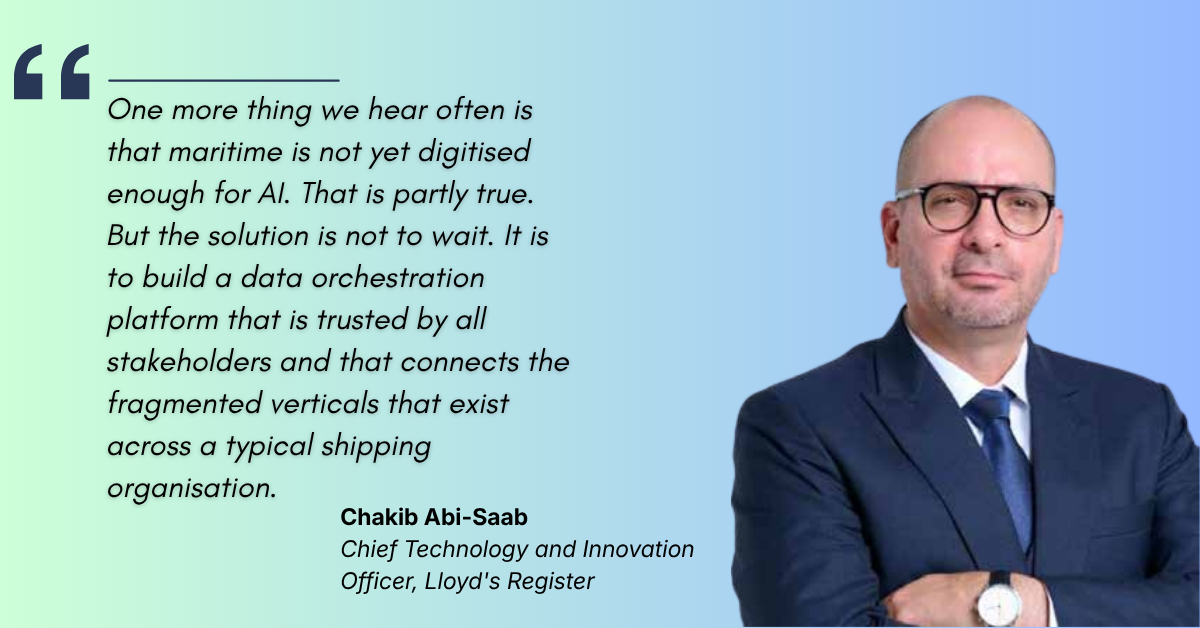
“One more thing we hear often is that maritime is not yet digitised enough for AI. That is partly true. But the solution is not to wait. It is to build a data orchestration platform that is trusted by all stakeholders and that connects the fragmented verticals that exist across a typical shipping organisation.”
AI and predictive analytics are being cited as the next frontier for fleet management. Where in Lloyd’s Digital Maturity Model do these capabilities typically appear, and what foundational data infrastructure must be in place before they deliver real value?
The honest answer is that most organisations have not yet reached the stage where true predictive analytics are delivering transformational value. What we tend to see is solutions that help companies do what they already do, but faster and more efficiently. That matters, but it is not the same as changing the operational model to take genuine advantage of AI. To get there, you have to start with processes, not technology. Here is what we observe in almost every company: a process that has, say, twelve steps. You reengineer it and reduce it to six. Only then does AI become relevant: from those six reengineered steps, how do you use data and automation to reduce human intervention further? Now you have two or three touchpoints where humans are genuinely needed, and something that previously took a week takes a day.
Without fixing the processes first, none of the rest works. And in terms of digital maturity, the picture is uneven within organisations, not just between them. Some departments are significantly more advanced than others, and which departments those are varies entirely from company to company. It depends almost entirely on the vision and drive of the individual leading that department. There is no uniform pattern I can point to.
Interoperability remains a persistent pain point. OEM systems, third-party software, legacy ECDIS and PMS platforms rarely speak the same language. What is Lloyd’s Register’s approach to building ecosystems that are genuinely open rather than proprietary?
The fragmentation you are describing is present at every level of the industry. And it is becoming more complex, not less, because geopolitical pressures are now driving a shift from global platforms towards regional ecosystems. That creates a new and significant challenge: how do you choose the right digital ecosystem, and how do you ensure it remains interoperable with ecosystems in other parts of the world?
The OEM dimension is particularly difficult. OEMs maintain very tight control over their data because they fear that sharing it with operators, or with competitors who service the same equipment, will erode their commercial position. But that control is precisely what prevents the predictive analytics capability that the entire industry is trying to unlock.
Predictive maintenance, for example, requires OEMs to share information they are not currently sharing. And it requires them to change their commercial policies. Even if the technology to achieve this is available today, the data is not flowing.
This is not a problem that any single organisation can solve alone. It requires industry-wide coordination, and it requires trusted intermediaries that all parties are comfortable sharing data with. That is a role Lloyd’s Register is well placed to take on, given our history of neutrality and our position as a classification society and advisor rather than a commercial operator.
“The maritime industry is at an interesting generational inflection point. The new generation entering the workforce is highly technology-driven, motivated, and expects to use digital tools at sea the same way they use smartphones at home. The generation still working, and who will be working for some years yet, is primarily manual-process oriented. Push too hard and you lose their support; not hard enough and you fail to attract the next generation.”
Seafarer adoption is often cited as the weakest link in any digital rollout. Tools go unused or get worked around. How is Lloyd’s Register embedding change management into ecosystem design, rather than treating it as an afterthought?
Our Digital Maturity Index looks at this explicitly. We assess adoption of technologies, how well those technologies are aligned with organisational objectives, cybersecurity culture, and the capacity for continuous improvement through training. These are not peripheral considerations; they are central to whether a digital programme succeeds.
The maritime industry is at an interesting generational inflection point. The new generation entering the workforce is highly technology-driven, motivated, and expects to use digital tools at sea the same way they use smartphones at home. The generation still working, and who will be working for some years yet, is primarily manual-process oriented. Push too hard and you lose their support; not hard enough and you fail to attract the next generation. It is a genuine and delicate balance.
What we have learned, and what we make central to our recommendations, is that technology adoption almost always starts with the user. If you do not design with the seafarer in mind from the beginning, you will not succeed, regardless of how good the technology is. And resistance to change, when we encounter it, is almost never bad intent. It is usually a combination of three things: not understanding what the technology actually does, fear that it will eliminate their role, and simply not knowing enough about it. When you take the time to explain the end goal, and specifically what is in it for the people being asked to change, you consistently find more support than expected. The problem is that as an industry, we are not yet good at communicating the why.
Indian shipping companies, particularly mid-sized bulk and coastal operators, are often caught between legacy infrastructure and pressure to digitise. What specific guidance does the Digital Maturity Index offer at the early-to-mid stage of that journey? And are India-specific benchmarks being developed?
There is no one-size-fits-all solution, and the maturity index reflects that. Every organisation we assess has a different starting point, and different departments within the same organisation can be at very different stages. What the index allows us to do is be specific rather than generic: here is where you are, here is where you need to be, here are the realistic steps to close that gap.
But there is a bigger question that I want to raise, because it is something people in this position will start hearing a great deal about in the next two to three years. The question is this: should an organisation spend the next two to three years fixing legacy systems and cleaning data in order to enable AI? Or should it use that same investment to rebuild what it has, on the side, from scratch, in a way that is faster, cheaper, scalable and modern? This is the critical strategic question of the next five years for technology leaders in shipping. It is the chicken-and-egg dilemma of our time.
Fix the legacy and you are investing in something that delivers value two or three years from now, not today. Rebuild on the side and by the time you finish, you have something fully modern and scalable, but you may have lost continuity with the historical data and operational knowledge accumulated over years. Neither path is obviously correct, and the right answer depends on what you are actually trying to achieve.
Which brings us back to where we started: you have to begin with the outcome. Not all data needs to be retained. Not everything that can be measured should be measured, and not everything that should be measured can be measured. Once you are clear on the goal, you can determine what data you actually need, and how much history is necessary. Sometimes the answer is ten years of data. Sometimes it is twelve months. It depends entirely on the problem you are trying to solve.
 Join our WhatsApp channel for more updates:
 Subscribe to our YouTube channel for more updates: