
Production capacity is only half the growth story. Sourcing, inland logistics, rail and road freight, gateway connectivity and export access decide how far and how fast, a manufacturer can scale.

Introduction: Manufacturing growth begins beyond the factory floor
A manufacturing business can invest in advanced machinery, expand production capacity, hire skilled workers and develop innovative products. Yet, despite these investments, growth can remain limited if raw materials do not arrive on time, transportation costs continue to rise, or finished goods struggle to reach their intended markets.
The reason is simple: manufacturing growth depends on more than production capacity. It depends on the efficiency of the entire manufacturing supply chain. From sourcing raw materials and managing inventory to moving goods through inland transportation networks, rail corridors, roads, ports and international shipping routes, every stage influences how efficiently a manufacturing business operates. A delay at any point can affect production schedules, increase operating costs, disrupt customer commitments and reduce the competitiveness of the final product.
For manufacturers in India, this challenge is particularly relevant as businesses look to expand their domestic presence, strengthen industrial networks and reach international markets. As manufacturing activity grows, the supporting logistics infrastructure must also become more efficient, connected and responsive.
A factory may have the capacity to produce more, but can its supply chain support that growth? This question is becoming increasingly important for manufacturers, logistics providers, infrastructure developers and policymakers. The ability to move materials and finished products efficiently is no longer just an operational consideration. It is a strategic advantage that can determine how quickly a business scales.
Your manufacturing business can grow only as fast as your supply chain allows.
Understanding where bottlenecks emerge and how production, sourcing, inland logistics, rail and road transportation, gateway connectivity and export markets work together is essential to building a resilient and competitive manufacturing business. This article examines each link in that chain, the bottlenecks that most often hold manufacturers back, and a practical roadmap for removing them.
PART ONE: THE SUPPLY CHAIN AS A GROWTH SYSTEM
1. Understanding the manufacturing supply chain
A manufacturing supply chain is the network of suppliers, facilities, transportation systems, logistics providers, distribution channels and customers involved in converting raw materials into finished products and delivering them to their final destinations. It connects every stage of the manufacturing process, beginning with the procurement of materials and ending with delivery to the customer or international buyer.
Although manufacturing is often associated with factory operations, the complete supply chain extends far beyond the production facility. It includes the movement of inputs into the factory, the coordination of inventory and production schedules, the transportation of finished goods, warehousing, distribution and export handling.
A typical manufacturing supply chain follows this sequence:

Each stage depends on the performance of the others. For instance, a manufacturer may have sufficient production capacity but experience frequent delays because raw materials arrive late. Another business may produce high-quality goods at competitive prices but struggle to secure international orders because transportation costs make its products expensive in overseas markets. In both situations, the challenge extends beyond manufacturing itself.
An efficient manufacturing supply chain helps businesses coordinate these interconnected activities, improve visibility, reduce unnecessary costs and respond more effectively to changes in demand. For manufacturers planning expansion, supply chain management must therefore become part of the growth strategy from the beginning.
PART TWO: FOLLOWING THE CHAIN, LINK BY LINK
2. Sourcing: The first link in a reliable supply chain
Every manufacturing process begins with sourcing. Raw materials, components, spare parts and specialized inputs must be available in the right quantities, at the right time and at a commercially viable cost. Any disruption in procurement can affect the entire production schedule.
For manufacturers, sourcing decisions influence more than the purchase price of materials. They also affect transportation costs, inventory levels, lead times and the ability to maintain uninterrupted operations. A supplier offering lower prices may not always be the most economical option if its location, transportation requirements or delivery reliability create additional costs. Similarly, dependence on a limited number of suppliers can expose manufacturers to disruptions caused by production failures, transport delays, changing trade conditions or unexpected increases in demand.
Why sourcing and logistics must work together
Effective sourcing requires manufacturers to evaluate suppliers based on their overall contribution to supply chain performance. Important considerations include:
• Supplier location: How far must materials travel before reaching the manufacturing facility?
• Transportation access: Are reliable roads, rail or other freight options available?
• Lead times: How much time is required between placing an order and receiving the materials?
• Supply reliability: Can suppliers maintain consistent delivery schedules?
• Inventory requirements: How much stock must be maintained to account for transportation uncertainty?
• Alternative sourcing: Are backup suppliers available if the primary source experiences a disruption?
These factors are particularly important for manufacturers operating across multiple states or sourcing materials internationally. An integrated approach to sourcing and logistics can improve inventory planning, reduce avoidable transportation expenses, and help businesses manage uncertainty more effectively.
For Indian manufacturers, stronger connections between industrial clusters, supplier networks, inland transport systems and major logistics gateways can also improve access to domestic and international inputs. A reliable manufacturing supply chain begins long before the production line starts operating. It begins with decisions about where materials come from and how reliably they can reach the factory.
3. Production capacity: Can your factory deliver what the market demands?
Production is the center of manufacturing operations. It determines how much a business can produce, how consistently it can maintain quality and how effectively it can respond to customer demand. However, production capacity alone does not guarantee business growth.
Manufacturers frequently invest in additional machinery, larger facilities, automation and skilled labor to increase output. These investments can improve productivity, but their benefits depend on the availability of materials, the reliability of supporting services, and the ability to move finished products efficiently.
Consider a manufacturer that upgrades its facility to increase output. If the new production line depends on imported components that regularly arrive late, the additional capacity may remain underutilized. Similarly, if finished products accumulate because transportation arrangements cannot accommodate higher volumes, the factory may face storage pressure and delayed deliveries. In such cases, the limitation is not the production process itself. It is the manufacturing supply chain supporting that process.
Aligning production with logistics capacity
Manufacturers need to evaluate production plans alongside procurement schedules, inventory requirements and transportation availability. This involves asking several important questions:
• Can suppliers consistently deliver the required materials within the planned production cycle?
• Is sufficient warehouse capacity available to manage incoming materials and finished goods?
• Can transport providers accommodate increases in production volumes?
• Are delivery schedules aligned with customer requirements and shipping deadlines?
• Can the existing logistics network support future expansion?
Answering these questions helps manufacturers identify constraints before they disrupt operations. Production planning should not happen in isolation. It should be integrated with supply chain planning so that increased output translates into actual business growth.
Ultimately, the objective is not simply to manufacture more products. It is to manufacture efficiently, maintain reliable delivery schedules, and move goods to market without creating additional bottlenecks.
4. Inland logistics: Connecting industrial clusters to markets
Inland logistics is one of the most important components of the manufacturing supply chain. It includes the movement, storage, handling and coordination of goods between manufacturing facilities, suppliers, distribution centres, warehouses, industrial clusters and major transport gateways.
While ports and international shipping often receive considerable attention in discussions about global trade, the journey to and from these gateways is equally important. Manufacturing facilities are spread across industrial estates, special economic zones, production clusters and inland commercial centers. Their ability to access reliable transportation networks directly influences the cost and speed of moving goods.
If an industrial facility is located far from a major transport corridor, lacks reliable freight connectivity or faces frequent congestion, its logistics costs can increase. These additional expenses may affect product pricing, delivery reliability and the manufacturer’s ability to compete.
The importance of first-mile and last-mile connectivity
The first mile connects suppliers or manufacturing facilities to the broader logistics network. The last mile connects distribution centres, gateways or transport terminals to their final destinations. Both stages can create bottlenecks when infrastructure and coordination are inadequate.
For example, a manufacturer may produce components in an inland industrial cluster and transport them to a distribution centre before shipping them overseas. If the initial road journey is unreliable, the shipment may miss its scheduled departure, resulting in additional handling, storage or rescheduling costs. Similarly, delays in moving imported raw materials from a port to a factory can affect production schedules even when the international shipment arrives on time.
Improving inland logistics requires more than adding vehicles to the road. It involves better route planning, reliable transport services, efficient loading and unloading, appropriate warehousing, digital tracking and stronger connections between different transport modes.
Inland logistics as a driver of industrial competitiveness
An efficient inland logistics network can help manufacturers access a wider supplier base, serve customers across multiple regions and reach international gateways more reliably. It can also improve the viability of manufacturing in locations beyond major metropolitan centres, provided that the necessary infrastructure and services are available.
For India’s manufacturing ambitions, connecting industrial clusters to logistics hubs, freight corridors, rail terminals and ports is essential to creating a more integrated industrial ecosystem. The more effectively inland logistics connects production to transportation networks, the easier it becomes for manufacturers to convert production capacity into market access.
5. Road and rail transportation: Finding the right freight mix
Road and rail transportation play complementary roles in the manufacturing supply chain. Road transport provides flexibility, extensive reach and convenient access to factories, warehouses and customers. Rail transport can be particularly suitable for large-volume and long-distance freight movements where appropriate infrastructure, terminal access and service availability exist.
The right transportation strategy depends on the type of cargo, shipment volume, distance, delivery urgency, available infrastructure and overall logistics costs. Relying exclusively on one transport mode may limit flexibility or increase exposure to specific disruptions. A well-planned combination of road and rail can help manufacturers balance cost, speed and reliability.
The role of road transportation
Road transportation remains important for moving goods between suppliers and factories, connecting industrial facilities to rail terminals and ports, and delivering products to distribution centres or customers. Its flexibility makes it valuable for shorter journeys, dispersed destinations and shipments requiring direct delivery.
However, road freight can be affected by congestion, fuel price fluctuations, vehicle availability, infrastructure quality, regulatory requirements and delays at loading or unloading points. For manufacturers handling frequent shipments, even small inefficiencies across multiple journeys can increase overall logistics expenditure. Improved route planning, load optimisation, vehicle utilisation and coordination between dispatch schedules and receiving facilities can help address these challenges.
The role of rail transportation
Rail can offer advantages for suitable high-volume and long-distance freight movements. Its effectiveness, however, depends on terminal accessibility, service frequency, handling requirements, scheduling and the availability of reliable connections at both ends of the journey.
Manufacturers must assess whether their cargo volumes and delivery requirements justify rail-based transportation, either independently or as part of a multimodal arrangement. Rail connectivity becomes especially valuable when industrial facilities can access suitable freight terminals without excessive additional road transportation.
Why multimodal logistics matters
Multimodal logistics involves using two or more modes of transportation within a coordinated movement of goods. For example, a manufacturer may move products by road from its factory to a rail terminal, use rail for the longer inland journey and then transfer the shipment to road transport for delivery to a port or distribution centre. The objective is to use each transport mode where it offers the greatest operational advantage.
A successful multimodal strategy requires coordination across schedules, documentation, cargo handling, terminal operations and delivery commitments. Without this coordination, transfers between modes can introduce delays rather than improve efficiency.
For manufacturers, the central question is not whether road or rail is universally better. It is how the available transport options can be combined to create the most reliable and cost-effective manufacturing supply chain.
6. Gateway connectivity: The link between manufacturing and global trade
A logistics gateway connects inland production and distribution networks with wider domestic or international transportation systems. Ports are particularly important gateways for manufacturers involved in international trade. For export-oriented businesses, gateway connectivity can influence shipping schedules, freight costs, inventory planning and the reliability of customer deliveries.
However, the efficiency of a gateway cannot be measured only by the performance of the port itself. The wider network matters too. A port may offer suitable cargo-handling facilities, but manufacturers also need dependable inland transportation, efficient documentation, coordinated cargo arrivals and access to shipping services that meet their requirements. If these supporting connections are inefficient, the overall logistics journey may remain costly or unpredictable.
Why port connectivity matters to manufacturers
Consider a manufacturing business located in an inland industrial cluster that exports engineering components to international buyers. The goods must travel from the factory to a suitable port, complete the necessary export processes, meet the relevant vessel schedule and continue through the international shipping network.
If the inland journey is poorly coordinated, the shipment may arrive too late for its intended sailing. The manufacturer may then need to manage additional storage, revised shipping arrangements or changes to customer delivery commitments. These issues can affect both operating costs and customer confidence.
Strong port connectivity helps manufacturers plan the movement of goods with greater predictability. It can also support access to international markets by connecting inland industrial regions to maritime trade networks.
Building an integrated gateway ecosystem
Improving gateway connectivity involves coordination between ports, road networks, rail infrastructure, logistics parks, container terminals, customs processes and freight service providers. Digital visibility can further improve the coordination of shipments and help stakeholders identify potential delays earlier.
For manufacturing businesses, the objective is to reduce unnecessary interruptions between the factory and the export gateway. A more integrated logistics ecosystem allows manufacturers to plan shipments around production schedules, improve inventory control and fulfil international orders more reliably.
Gateway connectivity should therefore be viewed as an extension of manufacturing infrastructure, not as a separate activity that begins only after goods leave the factory.
7. Export markets: Where supply chain efficiency becomes a competitive advantage
International markets create opportunities for manufacturers to expand sales, diversify customers and increase production volumes. However, entering an export market requires more than producing a product that meets international quality standards. Manufacturers must also deliver that product at a competitive total cost, within the required timeframe and in compliance with relevant trade requirements. The manufacturing supply chain plays a central role in achieving these objectives.
International buyers evaluate suppliers on several dimensions, including product quality, pricing, delivery reliability, communication, consistency and their ability to respond to changing requirements. A manufacturer that consistently meets delivery commitments may be better positioned to build long-term customer relationships than a competitor whose shipments frequently arrive late.
The relationship between logistics costs and export competitiveness
The final delivered cost of a manufactured product includes more than the cost of raw materials and factory operations. Depending on the shipment and commercial arrangement, it can also include packaging, inland freight, cargo handling, warehousing, documentation, customs-related charges, port handling, international freight, insurance and other applicable expenses.
When logistics costs rise, manufacturers may have less room to offer competitive prices without reducing margins. This is particularly relevant for products that compete in price-sensitive international markets. Improving the manufacturing supply chain can help businesses identify avoidable costs, select suitable transportation options and reduce unnecessary inventory or handling.
Reliability matters as much as speed
Faster transportation is not always the most economical or appropriate option. Manufacturers need a supply chain that meets delivery requirements consistently. Predictable lead times allow businesses to coordinate production schedules, manage inventory and communicate more confidently with buyers. Greater reliability can also reduce the need to maintain excessive buffer stock or make costly last-minute arrangements.
For export-oriented manufacturers, supply chain efficiency is therefore about balancing speed, cost, resilience and service quality.
Building stronger export capabilities
Manufacturers looking to enter new international markets should assess their logistics capabilities alongside product readiness and commercial strategy. This includes understanding destination-market requirements, shipping routes, cargo handling needs, documentation procedures, freight availability and delivery expectations.
A well-connected manufacturing supply chain helps transform export potential into operational capability. When businesses can move goods reliably from production facilities to international buyers, they are better equipped to pursue new opportunities and scale their global presence.
PART THREE: FINDING AND FIXING THE CONSTRAINTS
8. Identifying supply chain bottlenecks before they limit growth
Every supply chain has constraints. The challenge is identifying which constraints create the greatest impact and addressing them before they limit business performance.
A bottleneck is any point in a process where capacity, delays, limited resources or inefficient coordination restrict the movement of materials or finished goods. In manufacturing, bottlenecks can emerge at several stages, including procurement, production, warehousing, transportation, terminal handling and export processing.
A business may initially assume that rising logistics costs are caused by freight rates, only to discover that poor scheduling, low vehicle utilisation or repeated waiting times are contributing significantly to the problem. Similarly, a factory may appear to have a production capacity issue when the underlying challenge is an unreliable supply of materials.
Seven common manufacturing supply chain bottlenecks
1. Unreliable raw material supply. Delayed deliveries, limited supplier options and unpredictable lead times can interrupt production and increase inventory requirements.
2. Production and dispatch misalignment. Finished goods may remain at the factory because transport arrangements are not available when production is completed.
3. Transportation inefficiencies. Poor route planning, underutilised vehicles, congestion and inadequate coordination can increase the cost and time required to move goods.
4. Limited warehouse and storage capacity. Insufficient or poorly managed storage can create congestion, handling difficulties and delays in receiving or dispatching cargo.
5. Weak rail and road integration. Inadequate access to terminals, inconvenient transfer arrangements or disconnected schedules can make multimodal transportation less effective.
6. Gateway and documentation delays. Missed cargo cut-off times, incomplete paperwork, congestion or operational constraints may disrupt planned export movements.
7. Limited supply chain visibility. When manufacturers cannot track shipments or access timely information, they may struggle to respond to disruptions and communicate accurate delivery estimates.
How manufacturers can identify the real constraint
The first step is to map the complete journey of materials and finished products. Businesses should document the movement from sourcing to production, dispatch, inland transportation, gateway processing and final delivery. They can then measure performance at each stage using relevant indicators:
These measurements help distinguish isolated incidents from recurring operational problems. The next step is to prioritise improvements based on business impact, implementation cost and feasibility.
Not every bottleneck requires a major infrastructure investment. Some can be addressed through better scheduling, improved information sharing, revised procurement practices or more effective coordination between logistics partners. Others may require changes in transport mode, additional terminal access, stronger infrastructure connections or collaboration across the wider logistics ecosystem.
The key is to address the constraint that limits the performance of the entire chain rather than optimising one activity in isolation.
Your Manufacturing Business Can Grow Only as Fast as Your Supply Chain Allows
Production capacity is only half the growth story. Sourcing, inland logistics, rail and road freight, gateway connectivity and export access decide how far, and how fast, a manufacturer can scale.
Introduction: Manufacturing growth begins beyond the factory floor
A manufacturing business can invest in advanced machinery, expand production capacity, hire skilled workers and develop innovative products. Yet, despite these investments, growth can remain limited if raw materials do not arrive on time, transportation costs continue to rise, or finished goods struggle to reach their intended markets.
The reason is simple: manufacturing growth depends on more than production capacity. It depends on the efficiency of the entire manufacturing supply chain. From sourcing raw materials and managing inventory to moving goods through inland transportation networks, rail corridors, roads, ports and international shipping routes, every stage influences how efficiently a manufacturing business operates. A delay at any point can affect production schedules, increase operating costs, disrupt customer commitments and reduce the competitiveness of the final product.
For manufacturers in India, this challenge is particularly relevant as businesses look to expand their domestic presence, strengthen industrial networks and reach international markets. As manufacturing activity grows, the supporting logistics infrastructure must also become more efficient, connected and responsive.
A factory may have the capacity to produce more, but can its supply chain support that growth? This question is becoming increasingly important for manufacturers, logistics providers, infrastructure developers and policymakers. The ability to move materials and finished products efficiently is no longer just an operational consideration. It is a strategic advantage that can determine how quickly a business scales.
Your manufacturing business can grow only as fast as your supply chain allows.
Understanding where bottlenecks emerge, and how production, sourcing, inland logistics, rail and road transportation, gateway connectivity and export markets work together, is essential to building a resilient and competitive manufacturing business. This article examines each link in that chain, the bottlenecks that most often hold manufacturers back, and a practical roadmap for removing them.
PART ONE: THE SUPPLY CHAIN AS A GROWTH SYSTEM
1. Understanding the manufacturing supply chain
A manufacturing supply chain is the network of suppliers, facilities, transportation systems, logistics providers, distribution channels and customers involved in converting raw materials into finished products and delivering them to their final destinations. It connects every stage of the manufacturing process, beginning with the procurement of materials and ending with delivery to the customer or international buyer.
Although manufacturing is often associated with factory operations, the complete supply chain extends far beyond the production facility. It includes the movement of inputs into the factory, the coordination of inventory and production schedules, the transportation of finished goods, warehousing, distribution and export handling.
A typical manufacturing supply chain follows this sequence:
| 1 Sourcing | 2 Production | 3 Inland Logistics | 4 Rail and Road Freight | 5 Gateway Connectivity | 6 Export Market |
Each stage depends on the performance of the others. For instance, a manufacturer may have sufficient production capacity but experience frequent delays because raw materials arrive late. Another business may produce high-quality goods at competitive prices but struggle to secure international orders because transportation costs make its products expensive in overseas markets. In both situations, the challenge extends beyond manufacturing itself.
An efficient manufacturing supply chain helps businesses coordinate these interconnected activities, improve visibility, reduce unnecessary costs and respond more effectively to changes in demand. For manufacturers planning expansion, supply chain management must therefore become part of the growth strategy from the beginning.
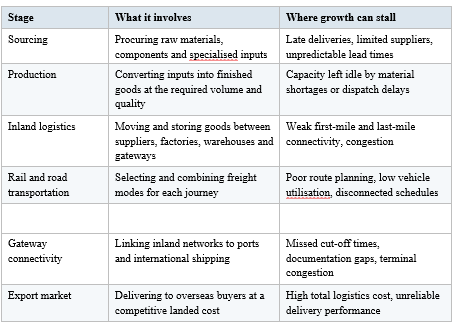
| Stage | What it involves | Where growth can stall |
| Sourcing | Procuring raw materials, components and specialised inputs | Late deliveries, limited suppliers, unpredictable lead times |
| Production | Converting inputs into finished goods at the required volume and quality | Capacity left idle by material shortages or dispatch delays |
| Inland logistics | Moving and storing goods between suppliers, factories, warehouses and gateways | Weak first-mile and last-mile connectivity, congestion |
| Rail and road transportation | Selecting and combining freight modes for each journey | Poor route planning, low vehicle utilisation, disconnected schedules |
| Gateway connectivity | Linking inland networks to ports and international shipping | Missed cut-off times, documentation gaps, terminal congestion |
| Export market | Delivering to overseas buyers at a competitive landed cost | High total logistics cost, unreliable delivery performance |
PART TWO: FOLLOWING THE CHAIN, LINK BY LINK
2. Sourcing: The first link in a reliable supply chain
Every manufacturing process begins with sourcing. Raw materials, components, spare parts and specialised inputs must be available in the right quantities, at the right time and at a commercially viable cost. Any disruption in procurement can affect the entire production schedule.
For manufacturers, sourcing decisions influence more than the purchase price of materials. They also affect transportation costs, inventory levels, lead times and the ability to maintain uninterrupted operations. A supplier offering lower prices may not always be the most economical option if its location, transportation requirements or delivery reliability create additional costs. Similarly, dependence on a limited number of suppliers can expose manufacturers to disruptions caused by production failures, transport delays, changing trade conditions or unexpected increases in demand.
Why sourcing and logistics must work together
Effective sourcing requires manufacturers to evaluate suppliers based on their overall contribution to supply chain performance. Important considerations include:
• Supplier location: How far must materials travel before reaching the manufacturing facility?
• Transportation access: Are reliable road, rail or other freight options available?
• Lead times: How much time is required between placing an order and receiving the materials?
• Supply reliability: Can suppliers maintain consistent delivery schedules?
• Inventory requirements: How much stock must be maintained to account for transportation uncertainty?
• Alternative sourcing: Are backup suppliers available if the primary source experiences a disruption?
These factors are particularly important for manufacturers operating across multiple states or sourcing materials internationally. An integrated approach to sourcing and logistics can improve inventory planning, reduce avoidable transportation expenses and help businesses manage uncertainty more effectively.
For Indian manufacturers, stronger connections between industrial clusters, supplier networks, inland transport systems and major logistics gateways can also improve access to domestic and international inputs. A reliable manufacturing supply chain begins long before the production line starts operating. It begins with decisions about where materials come from and how reliably they can reach the factory.
3. Production capacity: Can your factory deliver what the market demands?
Production is the centre of manufacturing operations. It determines how much a business can produce, how consistently it can maintain quality and how effectively it can respond to customer demand. However, production capacity alone does not guarantee business growth.
Manufacturers frequently invest in additional machinery, larger facilities, automation and skilled labour to increase output. These investments can improve productivity, but their benefits depend on the availability of materials, the reliability of supporting services and the ability to move finished products efficiently.
Consider a manufacturer that upgrades its facility to increase output. If the new production line depends on imported components that regularly arrive late, the additional capacity may remain underutilised. Similarly, if finished products accumulate because transportation arrangements cannot accommodate higher volumes, the factory may face storage pressure and delayed deliveries. In such cases, the limitation is not the production process itself. It is the manufacturing supply chain supporting that process.
Aligning production with logistics capacity
Manufacturers need to evaluate production plans alongside procurement schedules, inventory requirements and transportation availability. This involves asking several important questions:
• Can suppliers consistently deliver the required materials within the planned production cycle?
• Is sufficient warehouse capacity available to manage incoming materials and finished goods?
• Can transport providers accommodate increases in production volumes?
• Are delivery schedules aligned with customer requirements and shipping deadlines?
• Can the existing logistics network support future expansion?
Answering these questions helps manufacturers identify constraints before they disrupt operations. Production planning should not happen in isolation. It should be integrated with supply chain planning so that increased output translates into actual business growth.
Ultimately, the objective is not simply to manufacture more products. It is to manufacture efficiently, maintain reliable delivery schedules and move goods to market without creating additional bottlenecks.
4. Inland logistics: Connecting industrial clusters to markets
Inland logistics is one of the most important components of the manufacturing supply chain. It includes the movement, storage, handling and coordination of goods between manufacturing facilities, suppliers, distribution centres, warehouses, industrial clusters and major transport gateways.
While ports and international shipping often receive considerable attention in discussions about global trade, the journey to and from these gateways is equally important. Manufacturing facilities are spread across industrial estates, special economic zones, production clusters and inland commercial centres. Their ability to access reliable transportation networks directly influences the cost and speed of moving goods.
If an industrial facility is located far from a major transport corridor, lacks reliable freight connectivity or faces frequent congestion, its logistics costs can increase. These additional expenses may affect product pricing, delivery reliability and the manufacturer’s ability to compete.
The importance of first-mile and last-mile connectivity
The first mile connects suppliers or manufacturing facilities to the broader logistics network. The last mile connects distribution centres, gateways or transport terminals to their final destinations. Both stages can create bottlenecks when infrastructure and coordination are inadequate.
For example, a manufacturer may produce components in an inland industrial cluster and transport them to a distribution centre before shipping them overseas. If the initial road journey is unreliable, the shipment may miss its scheduled departure, resulting in additional handling, storage or rescheduling costs. Similarly, delays in moving imported raw materials from a port to a factory can affect production schedules even when the international shipment arrives on time.
Improving inland logistics requires more than adding vehicles to the road. It involves better route planning, reliable transport services, efficient loading and unloading, appropriate warehousing, digital tracking and stronger connections between different transport modes.
Inland logistics as a driver of industrial competitiveness
An efficient inland logistics network can help manufacturers access a wider supplier base, serve customers across multiple regions and reach international gateways more reliably. It can also improve the viability of manufacturing in locations beyond major metropolitan centres, provided that the necessary infrastructure and services are available.
For India’s manufacturing ambitions, connecting industrial clusters to logistics hubs, freight corridors, rail terminals and ports is essential to creating a more integrated industrial ecosystem. The more effectively inland logistics connects production to transportation networks, the easier it becomes for manufacturers to convert production capacity into market access.
5. Road and rail transportation: Finding the right freight mix
Road and rail transportation play complementary roles in the manufacturing supply chain. Road transport provides flexibility, extensive reach and convenient access to factories, warehouses and customers. Rail transport can be particularly suitable for large-volume and long-distance freight movements where appropriate infrastructure, terminal access and service availability exist.
The right transportation strategy depends on the type of cargo, shipment volume, distance, delivery urgency, available infrastructure and overall logistics costs. Relying exclusively on one transport mode may limit flexibility or increase exposure to specific disruptions. A well-planned combination of road and rail can help manufacturers balance cost, speed and reliability.
The role of road transportation
Road transportation remains important for moving goods between suppliers and factories, connecting industrial facilities to rail terminals and ports, and delivering products to distribution centres or customers. Its flexibility makes it valuable for shorter journeys, dispersed destinations and shipments requiring direct delivery.
However, road freight can be affected by congestion, fuel price fluctuations, vehicle availability, infrastructure quality, regulatory requirements and delays at loading or unloading points. For manufacturers handling frequent shipments, even small inefficiencies across multiple journeys can increase overall logistics expenditure. Improved route planning, load optimisation, vehicle utilisation and coordination between dispatch schedules and receiving facilities can help address these challenges.
The role of rail transportation
Rail can offer advantages for suitable high-volume and long-distance freight movements. Its effectiveness, however, depends on terminal accessibility, service frequency, handling requirements, scheduling and the availability of reliable connections at both ends of the journey.
Manufacturers must assess whether their cargo volumes and delivery requirements justify rail-based transportation, either independently or as part of a multimodal arrangement. Rail connectivity becomes especially valuable when industrial facilities can access suitable freight terminals without excessive additional road transportation.
Why multimodal logistics matters
Multimodal logistics involves using two or more modes of transportation within a coordinated movement of goods. For example, a manufacturer may move products by road from its factory to a rail terminal, use rail for the longer inland journey and then transfer the shipment to road transport for delivery to a port or distribution centre. The objective is to use each transport mode where it offers the greatest operational advantage.
A successful multimodal strategy requires coordination across schedules, documentation, cargo handling, terminal operations and delivery commitments. Without this coordination, transfers between modes can introduce delays rather than improve efficiency.
For manufacturers, the central question is not whether road or rail is universally better. It is how the available transport options can be combined to create the most reliable and cost-effective manufacturing supply chain.
6. Gateway connectivity: The link between manufacturing and global trade
A logistics gateway connects inland production and distribution networks with wider domestic or international transportation systems. Ports are particularly important gateways for manufacturers involved in international trade. For export-oriented businesses, gateway connectivity can influence shipping schedules, freight costs, inventory planning and the reliability of customer deliveries.
However, the efficiency of a gateway cannot be measured only by the performance of the port itself. The wider network matters too. A port may offer suitable cargo-handling facilities, but manufacturers also need dependable inland transportation, efficient documentation, coordinated cargo arrivals and access to shipping services that meet their requirements. If these supporting connections are inefficient, the overall logistics journey may remain costly or unpredictable.
Why port connectivity matters to manufacturers
Consider a manufacturing business located in an inland industrial cluster that exports engineering components to international buyers. The goods must travel from the factory to a suitable port, complete the necessary export processes, meet the relevant vessel schedule and continue through the international shipping network.
If the inland journey is poorly coordinated, the shipment may arrive too late for its intended sailing. The manufacturer may then need to manage additional storage, revised shipping arrangements or changes to customer delivery commitments. These issues can affect both operating costs and customer confidence.
Strong port connectivity helps manufacturers plan the movement of goods with greater predictability. It can also support access to international markets by connecting inland industrial regions to maritime trade networks.
Building an integrated gateway ecosystem
Improving gateway connectivity involves coordination between ports, road networks, rail infrastructure, logistics parks, container terminals, customs processes and freight service providers. Digital visibility can further improve the coordination of shipments and help stakeholders identify potential delays earlier.
For manufacturing businesses, the objective is to reduce unnecessary interruptions between the factory and the export gateway. A more integrated logistics ecosystem allows manufacturers to plan shipments around production schedules, improve inventory control and fulfil international orders more reliably.
Gateway connectivity should therefore be viewed as an extension of manufacturing infrastructure, not as a separate activity that begins only after goods leave the factory.
7. Export markets: Where supply chain efficiency becomes a competitive advantage
International markets create opportunities for manufacturers to expand sales, diversify customers and increase production volumes. However, entering an export market requires more than producing a product that meets international quality standards. Manufacturers must also deliver that product at a competitive total cost, within the required timeframe and in compliance with relevant trade requirements. The manufacturing supply chain plays a central role in achieving these objectives.
International buyers evaluate suppliers on several dimensions, including product quality, pricing, delivery reliability, communication, consistency and their ability to respond to changing requirements. A manufacturer that consistently meets delivery commitments may be better positioned to build long-term customer relationships than a competitor whose shipments frequently arrive late.
The relationship between logistics costs and export competitiveness
The final delivered cost of a manufactured product includes more than the cost of raw materials and factory operations. Depending on the shipment and commercial arrangement, it can also include packaging, inland freight, cargo handling, warehousing, documentation, customs-related charges, port handling, international freight, insurance and other applicable expenses.
When logistics costs rise, manufacturers may have less room to offer competitive prices without reducing margins. This is particularly relevant for products that compete in price-sensitive international markets. Improving the manufacturing supply chain can help businesses identify avoidable costs, select suitable transportation options and reduce unnecessary inventory or handling.
Reliability matters as much as speed
Faster transportation is not always the most economical or appropriate option. Manufacturers need a supply chain that meets delivery requirements consistently. Predictable lead times allow businesses to coordinate production schedules, manage inventory and communicate more confidently with buyers. Greater reliability can also reduce the need to maintain excessive buffer stock or make costly last-minute arrangements.
For export-oriented manufacturers, supply chain efficiency is therefore about balancing speed, cost, resilience and service quality.
Building stronger export capabilities
Manufacturers looking to enter new international markets should assess their logistics capabilities alongside product readiness and commercial strategy. This includes understanding destination-market requirements, shipping routes, cargo handling needs, documentation procedures, freight availability and delivery expectations.
A well-connected manufacturing supply chain helps transform export potential into operational capability. When businesses can move goods reliably from production facilities to international buyers, they are better equipped to pursue new opportunities and scale their global presence.
PART THREE: FINDING AND FIXING THE CONSTRAINTS
8. Identifying supply chain bottlenecks before they limit growth
Every supply chain has constraints. The challenge is identifying which constraints create the greatest impact and addressing them before they limit business performance.
A bottleneck is any point in a process where capacity, delays, limited resources or inefficient coordination restrict the movement of materials or finished goods. In manufacturing, bottlenecks can emerge at several stages, including procurement, production, warehousing, transportation, terminal handling and export processing.
A business may initially assume that rising logistics costs are caused by freight rates, only to discover that poor scheduling, low vehicle utilisation or repeated waiting times are contributing significantly to the problem. Similarly, a factory may appear to have a production capacity issue when the underlying challenge is an unreliable supply of materials.
Seven common manufacturing supply chain bottlenecks
1. Unreliable raw material supply. Delayed deliveries, limited supplier options and unpredictable lead times can interrupt production and increase inventory requirements.
2. Production and dispatch misalignment. Finished goods may remain at the factory because transport arrangements are not available when production is completed.
3. Transportation inefficiencies. Poor route planning, underutilised vehicles, congestion and inadequate coordination can increase the cost and time required to move goods.
4. Limited warehouse and storage capacity. Insufficient or poorly managed storage can create congestion, handling difficulties and delays in receiving or dispatching cargo.
5. Weak rail and road integration. Inadequate access to terminals, inconvenient transfer arrangements or disconnected schedules can make multimodal transportation less effective.
6. Gateway and documentation delays. Missed cargo cut-off times, incomplete paperwork, congestion or operational constraints may disrupt planned export movements.
7. Limited supply chain visibility. When manufacturers cannot track shipments or access timely information, they may struggle to respond to disruptions and communicate accurate delivery estimates.
How manufacturers can identify the real constraint
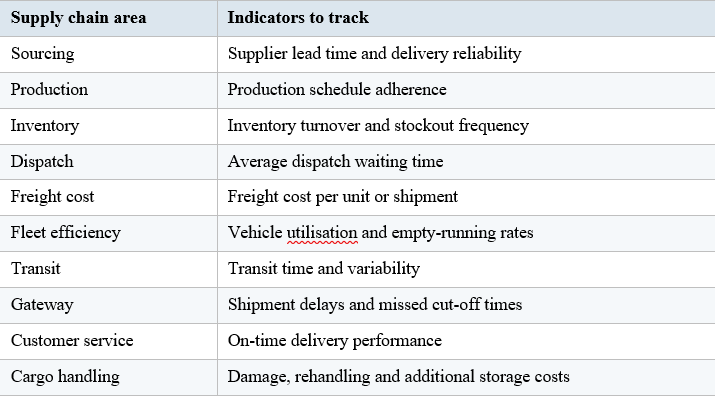
The first step is to map the complete journey of materials and finished products. Businesses should document the movement from sourcing to production, dispatch, inland transportation, gateway processing and final delivery. They can then measure performance at each stage using relevant indicators:
| Supply chain area | Indicators to track |
| Sourcing | Supplier lead time and delivery reliability |
| Production | Production schedule adherence |
| Inventory | Inventory turnover and stockout frequency |
| Dispatch | Average dispatch waiting time |
| Freight cost | Freight cost per unit or shipment |
| Fleet efficiency | Vehicle utilisation and empty-running rates |
| Transit | Transit time and variability |
| Gateway | Shipment delays and missed cut-off times |
| Customer service | On-time delivery performance |
| Cargo handling | Damage, rehandling and additional storage costs |
These measurements help distinguish isolated incidents from recurring operational problems. The next step is to prioritise improvements based on business impact, implementation cost and feasibility.
Not every bottleneck requires a major infrastructure investment. Some can be addressed through better scheduling, improved information sharing, revised procurement practices or more effective coordination between logistics partners. Others may require changes in transport mode, additional terminal access, stronger infrastructure connections or collaboration across the wider logistics ecosystem.
The key is to address the constraint that limits the performance of the entire chain rather than optimising one activity in isolation.
9. Digitalisation and data: Making the supply chain more visible
An efficient supply chain requires timely and accurate information. Manufacturers need to understand when materials will arrive, whether production is progressing according to plan, where finished goods are located and whether shipments are likely to meet their delivery schedules. Without this visibility, businesses often rely on manual updates, repeated follow-ups and reactive decision-making.
Digital supply chain tools can help bring this information together and support more coordinated operations. Depending on the organisation’s requirements, these tools may include enterprise resource planning systems, warehouse management systems, transport management systems, shipment tracking platforms and supplier collaboration portals.
From fragmented information to connected operations
When procurement, production, warehousing and transportation teams work with disconnected information, small changes can create unexpected problems. For example, a production team may complete an order earlier than planned, but the dispatch team may not receive the update in time to arrange transportation. Alternatively, a supplier delay may affect production, while the logistics team continues operating according to the original schedule.
Better information sharing can help prevent these mismatches. Integrated systems can improve coordination by providing updates on inventory, production requirements, shipment status and delivery schedules. Where reliable data is available, analytics can also help manufacturers identify recurring delays, compare transport options, estimate demand and assess the performance of logistics providers.
Practical applications of digital supply chain management
Manufacturers can begin with relatively focused improvements:
• Digitise shipment documentation and delivery records.
• Track supplier performance and lead-time variability.
• Monitor inventory levels against production requirements.
• Create shared dispatch schedules for internal teams and transport partners.
• Use shipment visibility tools to identify potential delays.
• Review logistics performance through regular data-based reporting.
Digitalisation cannot eliminate every physical infrastructure constraint. A tracking system cannot remove road congestion or create a missing rail connection. However, better information can help businesses plan around constraints, use existing capacity more effectively and respond to disruptions before they become more expensive.
The goal is not technology for its own sake. It is a more connected, transparent and responsive manufacturing supply chain.
10. Building supply chain resilience in an uncertain business environment
Supply chain efficiency is important, but efficiency alone is not enough. Manufacturers also need resilience: the ability to prepare for disruptions, respond to unexpected changes and restore operations without prolonged interruption.
Disruptions may arise from supplier failures, transportation delays, infrastructure constraints, extreme weather, changing demand, regulatory developments or interruptions in international trade. The impact of these disruptions depends partly on how much flexibility exists within the manufacturing supply chain. A business that relies on a single supplier, one transportation route or a tightly constrained delivery schedule may have fewer alternatives when something goes wrong.
Strategies for improving supply chain resilience
• Diversify critical suppliers where practical. Alternative sourcing arrangements can reduce dependence on a single supplier, although their value depends on qualification requirements, cost and material availability.
• Review inventory policies. Safety stock may help protect against certain disruptions, but inventory decisions should balance resilience against carrying costs, storage capacity and the risk of obsolescence.
• Evaluate alternative transport routes and modes. Where feasible, manufacturers can identify backup arrangements for important shipments.
• Improve supplier and logistics partner coordination. Regular communication can help businesses identify emerging problems and adjust schedules earlier.
• Develop contingency plans. Businesses should define how they will respond to common disruptions, including transport delays, material shortages and missed shipping schedules.
• Monitor supply chain performance continuously. Reviewing lead times, delivery reliability and recurring constraints can help manufacturers identify vulnerabilities before they become serious.
Resilience does not mean eliminating every possible risk. It means understanding where the business is vulnerable and ensuring that appropriate alternatives exist for critical operations. For manufacturers competing in domestic and international markets, a resilient supply chain can support continuity, protect customer relationships and make expansion more sustainable.
11. A practical roadmap for improving supply chain efficiency
Improving supply chain performance does not always require a complete transformation at once. Manufacturers can begin by identifying the most significant constraints and implementing changes in a structured manner. The following nine-step roadmap provides a practical starting point.
Step 1 Map the end-to-end supply chain
Document every major stage, from raw material sourcing to final delivery. Identify the facilities, suppliers, logistics partners and transport modes involved. This creates a shared understanding of how goods move through the business.
Step 2 Establish a performance baseline
Measure current lead times, logistics expenditure, inventory levels, dispatch delays and delivery reliability. Without a baseline, it is difficult to determine whether an improvement has delivered meaningful results.
Step 3 Identify the highest-impact bottlenecks
Determine which constraints contribute most significantly to delays, additional costs or missed customer commitments. Prioritise problems based on their frequency, business impact and feasibility of resolution.
Step 4 Review sourcing and inventory decisions
Evaluate supplier reliability, procurement lead times and the relationship between inventory policies and production schedules. Where appropriate, consider alternative suppliers or changes in ordering frequency.
Step 5 Optimise transportation choices
Compare road, rail and multimodal options based on total logistics cost, cargo characteristics, delivery requirements and available infrastructure. Avoid selecting a transport mode solely on the basis of its headline freight rate.
Step 6 Strengthen gateway connectivity
Review the movement of goods between the factory, inland terminals, warehouses and ports. Identify unnecessary waiting periods, documentation gaps, missed cut-off times and opportunities to improve coordination.
Step 7 Improve data visibility
Introduce practical tracking and reporting mechanisms to monitor shipments, inventory, supplier performance and delivery commitments. Start with the information needed to make better operational decisions.
Step 8 Develop contingency arrangements
Identify critical suppliers, transport routes and operational dependencies. Establish alternative arrangements where the cost and business impact justify them.
Step 9 Measure results and refine the process
Review performance regularly, compare results with the baseline and adjust the approach based on what the data reveals.
Supply chain improvement is an ongoing process. As production volumes, customer expectations and market conditions change, the manufacturing supply chain must evolve accordingly.
PART FOUR: THE BIGGER PICTURE
12. India’s manufacturing ambitions need stronger logistics integration
India’s manufacturing ecosystem includes a wide range of industries, from engineering goods, automotive components and textiles to electronics, chemicals, processed products and specialised industrial equipment. These industries differ in their sourcing requirements, transportation needs and export markets. Nevertheless, they share a common requirement: reliable movement of materials and finished goods.
As manufacturing businesses seek to improve competitiveness, logistics infrastructure becomes an important part of the broader industrial environment. Industrial clusters need efficient connections to suppliers, distribution networks, freight terminals, highways, rail corridors and ports. Businesses also benefit from coordinated logistics services, accessible warehousing and processes that support the timely movement of goods.
Connecting manufacturing clusters to freight networks
Manufacturing facilities located away from major gateways need reliable inland connections to reach domestic markets and international shipping services. Efficient links between industrial clusters and transport corridors can help reduce avoidable delays and improve the predictability of freight movement.
This is particularly relevant for businesses operating outside major metropolitan centres, where access to suitable logistics infrastructure can influence sourcing choices, distribution strategies and export opportunities.
Improving multimodal integration
Road, rail and maritime transportation each serve different functions. Their combined effectiveness depends on how well they connect. Infrastructure investments are more valuable when manufacturers can access the network efficiently and transfer cargo between modes without unnecessary delays or handling. This requires coordination among infrastructure providers, logistics operators, terminal managers, manufacturers and public authorities.
Looking beyond infrastructure creation
Building infrastructure is one part of the challenge. Ensuring that it is accessible, operationally efficient and aligned with industry requirements is equally important. Manufacturers need logistics systems that support their actual cargo volumes, delivery schedules and market needs. A road, rail terminal or port connection creates greater value when it fits into a functioning end-to-end supply chain.
For India, strengthening the relationship between manufacturing capacity and logistics capability can help businesses pursue growth opportunities with greater confidence. The broader objective is to build an industrial ecosystem in which production, transportation, infrastructure and trade work together rather than operate as separate systems.
13. The future of manufacturing growth depends on connected logistics
Manufacturing competitiveness is increasingly shaped by the ability to coordinate multiple activities across a complex network. Production capacity remains essential, but its commercial value depends on whether businesses can source inputs reliably, move goods efficiently, manage costs and reach customers when required.
The future of manufacturing logistics will therefore depend on stronger integration between physical infrastructure, digital systems, transport services and operational planning:
• Manufacturers will need to make more informed decisions about supplier networks, inventory strategies, transportation modes and export routes.
• Logistics providers will need to offer reliable services that respond to changing industrial requirements.
• Infrastructure stakeholders will need to consider how effectively individual assets connect to the wider supply chain.
For export-oriented businesses, these improvements can support more predictable deliveries and stronger customer relationships. For domestic manufacturers, they can help improve distribution efficiency and access to new markets.
The broader opportunity lies in treating the supply chain as an integrated system rather than a collection of independent activities. A factory can expand production. A logistics provider can improve transport services. A port can enhance cargo handling. A digital platform can increase visibility. But sustainable gains emerge when these improvements work together.
Manufacturing growth is not determined by what a factory can produce alone. It is also determined by how efficiently the entire supply chain can move that production to the market.
Conclusion: Where are the bottlenecks limiting your growth?
Manufacturing businesses often focus on improving what happens inside the factory. Yet many of the constraints that limit growth emerge outside its boundaries. Sourcing delays can interrupt production. Inefficient inland logistics can increase transportation costs. Poor road and rail coordination can disrupt cargo movement. Limited gateway connectivity can delay exports. Weak supply chain visibility can make it harder to respond to changing conditions. Each of these issues can affect the manufacturer’s ability to scale operations and compete effectively.
Addressing them requires a broader perspective, one that connects production planning, procurement, inland transportation, multimodal logistics, port connectivity and international market access.
For India, building a more competitive manufacturing ecosystem depends not only on increasing production capacity but also on ensuring that the logistics networks supporting that capacity are efficient, accessible and well connected. Manufacturers, logistics providers, infrastructure developers and policymakers all have a role to play in identifying constraints and developing practical solutions.
The important question is no longer simply how much a business can manufacture. It is how effectively its supply chain can support the next stage of growth. Where are the bottlenecks in your manufacturing supply chain, and what needs to change to remove them?
Join the conversation at the Smart Logistics Summit
Bring the conversation to the Smart Logistics Summit (SLS), where manufacturing, logistics and infrastructure stakeholders can explore the connections needed to improve supply chain efficiency, strengthen industrial competitiveness and support the next phase of business growth.
Your manufacturing business can grow only as fast as your supply chain allows. Let’s identify what is holding it back.
 Join our WhatsApp channel for more updates:
 Subscribe to our YouTube channel for more updates: