



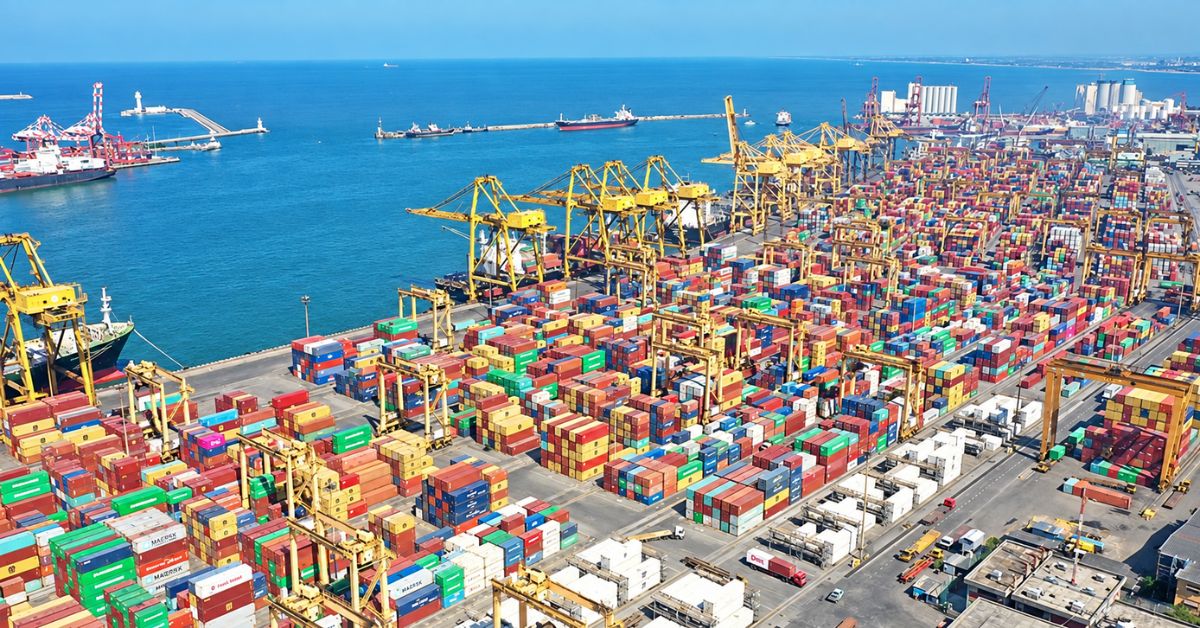

Congestion at the Port of Colombo is expected to continue for another two weeks before conditions begin to ease, with vessel turnaround times at the port’s deep-draft terminals extending to as much as six days. The pressure is being driven by a surge in cargo diverted from the Gulf, which is converging on a limited number of berths capable of handling the largest vessels.
Adverse weather conditions are adding to the operational challenges, with strong winds disrupting vessel movements and berthing operations. The delays are concentrated primarily at the Colombo International Container Terminal (CICT) and, to a lesser extent, the Colombo West International Terminal (CWIT), which are the two facilities equipped to handle the largest vessels currently calling at Colombo.
The South Asia Gateway Terminal (SAGT) and Jaya Container Terminal (JCT), meanwhile, are operating relatively close to normal levels. The additional demand is largely coming from vessels that require the deeper drafts available at CICT and CWIT.
Shipping lines have also reported delays at Colombo. During the last week of August, berthing delays of up to 24 to 36 hours were recorded for vessels with contracted berthing windows. High yard density, an inter-terminal transfer backlog of up to 35,000 TEUs and adverse weather conditions were among the factors contributing to the delays.
Congestion is also affecting other major Indian subcontinent gateways. Nhava Sheva recorded yard density of more than 90%, with delays reaching up to 48 hours, while Mundra’s yard density exceeded 77%, with delays of up to 24 hours.
The disruption follows a sharp decline in container volumes at Jebel Ali. The Dubai port handled 3.14 million TEUs during the first half of the year, nearly 60% lower than the 7.77 million TEUs recorded during the corresponding period a year earlier. Volumes in the second quarter alone fell by more than 90%.
With most vessels calling at Jebel Ali required to transit the Strait of Hormuz, shipping lines have redirected relay cargo to a limited number of South Asian terminals with sufficient draft to accommodate their vessels. This has placed additional pressure on Colombo’s deep-draft facilities.
The East Container Terminal has absorbed relatively little of the diverted cargo, with shipping lines showing limited commitment to fixed calls amid concerns over operational efficiency.
Navigation constraints within Colombo harbour are adding another layer of pressure. An insufficient tug fleet has slowed vessel movements and contributed to longer turnaround times. In July, approval was given to hire two tugboats from Sri Lanka Shipping Company Limited at a cost of $17.16 million, excluding taxes, over a five-year period. However, the vessels are not expected to enter service until next year.
Despite the congestion, Colombo has recorded strong growth in container volumes. Container throughput increased 7.3% year-on-year to 774,513 TEUs in July, taking total throughput for the first seven months of the year to 5,218,547 TEUs, an increase of 11.2%.
Transshipment volumes rose 8.4% year-on-year to 628,053 TEUs in July, while cumulative transshipment throughput for the first seven months reached 4,189,125 TEUs, up 11.4% from the same period last year.
Domestic container volumes declined 2.7% year-on-year to 113,006 TEUs in July. However, cumulative domestic volumes remained 6.6% higher at 793,918 TEUs during the first seven months.
Transshipment and re-stow cargo together accounted for 85.4% of Colombo’s total throughput in July, compared with 84.5% a year earlier. The growing share of relay cargo is placing greater pressure on available berth time and yard capacity.
Re-stowing volumes increased 27.5% year-on-year to 33,454 TEUs in July, growing at nearly four times the rate of overall container throughput.
Colombo’s rising volumes have also strengthened its position among the world’s leading container ports. The port moved from 26th to 20th in the global container port rankings based on first-half throughput of 4.44 million TEUs, entering the top 20 for the first time.
Based on the seven-month run rate, Colombo is on course to handle around 8.9 million TEUs for the full year, potentially surpassing its previous annual record of 8,291,178 TEUs set in 2025.
Capacity is also set to expand, with the second phase of the Colombo West International Terminal expected to be completed by December. The expansion will take the terminal’s annual handling capacity towards 3.2 million TEUs.
With diverted Gulf cargo continuing to place pressure on Colombo’s deep-draft terminals, weather-related disruptions and limited harbour resources could keep operational conditions challenging in the near term. However, the expected easing of the current cargo surge, combined with additional terminal capacity, could help relieve pressure over the coming months.
 Join our WhatsApp channel for more updates:
 Subscribe to our YouTube channel for more updates: