




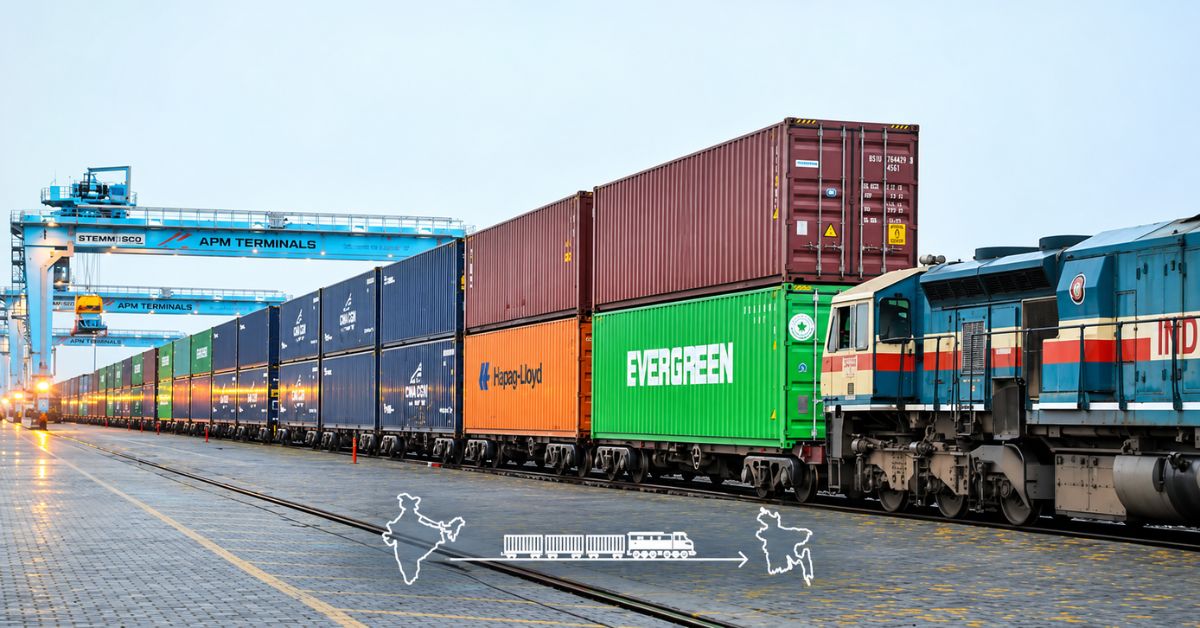

India has sought permission for private container train operators to carry cargo directly to inland destinations in Bangladesh, expanding the scope of bilateral rail freight services. Bangladesh has maintained that Indian Railways must accept full responsibility and liability for any private Indian operator permitted to use its network.
The proposal was discussed at the 38th Bangladesh–India Inter-Governmental Railway Meeting in Dhaka from 8 to 10 September 2026. The discussions covered operating hours, freight handling and arrangements for cross-border cargo bookings. Permission for private operators remains under consideration.
What changes has India proposed?
India requested round-the-clock freight operations on the Darshana–Gede, Petrapole–Benapole and Rohanpur–Singhabad routes. Bangladesh said longer operating hours should reflect trade volumes.
India also proposed direct booking between freight stations in both countries. Bangladesh favoured retaining the existing rebooking arrangement pending regulatory changes and capacity improvements.
For potential freight services connecting Chattogram port with Nischintapur in Tripura, Bangladesh requested formal proposals and cargo demand forecasts. These discussions concern proposed operating arrangements, rather than the launch of new services.
How did cross-border container services develop?
Containerised rail trade between the two countries predates the latest request for private operator access. The first container train reached Bangladesh through the Benapole–Petrapole link on 26 July 2020, carrying fast-moving consumer goods and fabrics in 50 containers.
The train originated at the Container Corporation of India’s terminal at Majerhat in Kolkata. Its arrival followed an April 2017 memorandum of understanding between the corporation and the Bangladesh Container Company, and a trial run to Bangabandhu Setu West station in April 2018.
The introduction of container and parcel services coincided with efforts to maintain essential supplies during the coronavirus pandemic, when road transport faced disruption. India’s Ministry of Railways reported that 103 freight trains carried essential goods and raw materials between the countries in June 2020.
India also handed over 10 broad-gauge locomotives to Bangladesh in July that year. The locomotives were modified to meet Bangladesh Railway’s requirements and support passenger and freight operations.
Which railway links support bilateral freight?
The cross-border network has expanded through the restoration of older railway connections. Regular freight operations on the Haldibari–Chilahati route began on 1 August 2021, with a stone-laden train dispatched from Damdim in India to Bangladesh.
At that time, it became the fifth operational connection, alongside Petrapole–Benapole, Gede–Darshana, Singhabad–Rohanpur and Radhikapur–Birol.
Haldibari–Chilahati had remained disconnected since 1965. Its restoration added another route for bilateral freight, complementing the established interchange points further south.
Connectivity with India’s north-east subsequently advanced through the Agartala–Akhaura project. An inaugural freight train travelled from Gangasagar in Bangladesh to Nischintapur in India on 1 November 2023, when a portion of the link was inaugurated.
The project’s alignment comprises 5.46 km in India and 6.78 km in Bangladesh. Indian authorities described it as the first railway project connecting the north-eastern states with Bangladesh, providing an additional route for bilateral trade.
What must happen before private services can begin?
The latest proposal would extend participation in an established cross-border freight market, but access depends on agreement over operational responsibility. Bangladesh’s requirement that Indian Railways assume liability remains central to further consideration.
Infrastructure capacity is also part of the discussions. Bangladesh identified locomotive, staffing and track limitations when responding to requests for faster train acceptance. The negotiations therefore involve both access arrangements and the practical ability to handle additional freight.
 Join our WhatsApp channel for more updates:
 Subscribe to our YouTube channel for more updates:




