




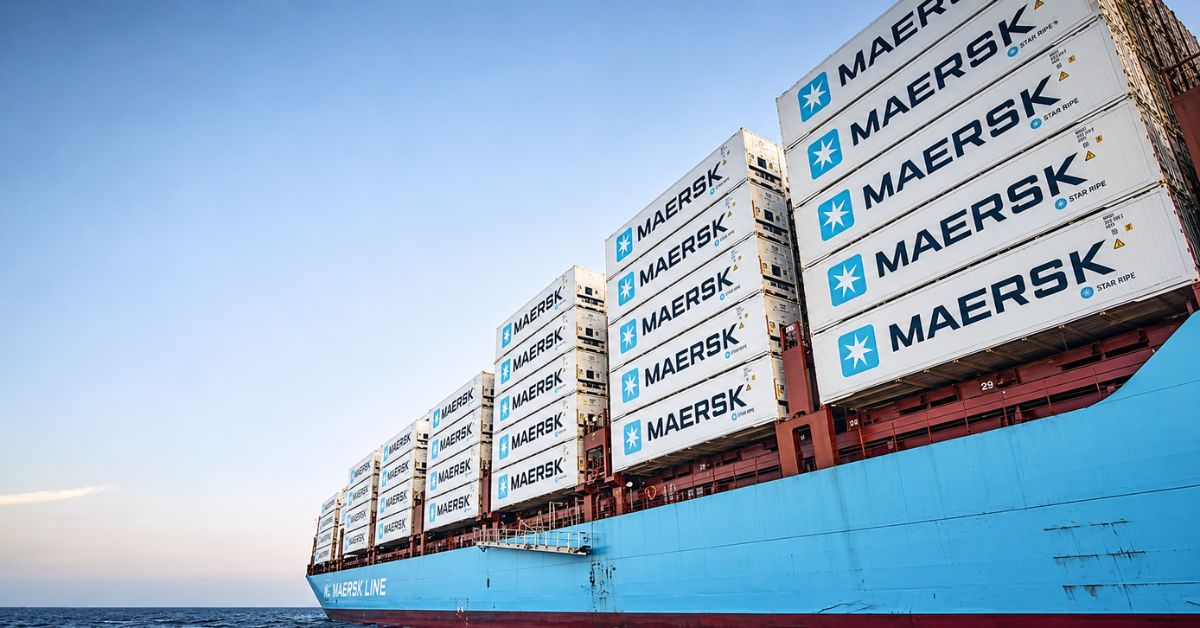

A.P. Moller–Maersk raised its full-year earnings guidance on 5 November after port congestion and resilient cargo demand lifted third-quarter freight rates. The Danish shipping and logistics group now expects underlying earnings before interest and tax (EBIT) of US$8 billion–US$8.5 billion in 2026, compared with its previous forecast of US$4.5 billion–US$6.5 billion.
Underlying earnings before interest, tax, depreciation and amortisation (EBITDA) are forecast at US$14 billion–US$14.5 billion, up from US$10.5 billion–US$12.5 billion. The revised outlook reflects third-quarter performance and improved visibility for the remainder of the year.
Why did port congestion push freight rates higher?
Severe typhoons in Asia disrupted port operations during the quarter, tying up vessels and reducing available shipping capacity. Maersk reported that global average port waiting times peaked at 16.6 hours, their highest level since January 2023.
The Shanghai Containerised Freight Index rose by an average of 46% compared with the preceding quarter. Global container demand increased by an estimated 2%–4% year on year, with growth in Africa, Latin America and North America partly offsetting weaker conditions elsewhere.
Maersk’s investor presentation also identified trade imbalances as a contributor to congestion. Vessel utilisation remained at 96% for a third consecutive quarter, while congestion constrained the company’s ability to increase cargo volumes.
How did Maersk’s ocean business perform?
Maersk’s average loaded freight rate reached US$3,287 per forty-foot equivalent unit (FFE), increasing approximately 46% year on year and 20% from the second quarter.
Loaded volumes declined 0.8% year on year to 3.37 million FFE. The figures show that stronger pricing, rather than higher shipment volumes, was the principal driver of the Ocean division’s improved performance.
Ocean EBITDA increased to US$3.7 billion from US$1.8 billion. However, operating costs rose 18% to US$8.7 billion as fuel, network and container-handling expenses increased.
Bunker costs climbed 37% to US$2.1 billion. Container-handling costs rose 9.3%, reflecting terminal congestion, while network costs excluding fuel increased 12%. Maersk attributed the latter to adjustments following the Strait of Hormuz closure and higher canal charges associated with its partial return to Suez.
What role did the Suez return play?
Maersk said its return to Red Sea routing, alongside network efficiencies and disruption-related changes, helped reduce bunker consumption. Higher fuel costs were recovered through contractual surcharges and spot freight rates.
The company expects returning services to Suez to help counter the effect of congestion on vessel productivity. This remains an operational response to constrained capacity, alongside fleet investment.
During September, Maersk announced orders for 26 container vessels of approximately 19,000 twenty-foot equivalent units each, as part of its fleet renewal and growth programme.
How did the wider group perform?
Group revenue increased 27% year on year to US$18.1 billion. EBITDA reached US$4.7 billion, while EBIT rose to US$3.3 billion.
Logistics & Services recorded 13% revenue growth and an EBIT margin of 5.8%.
The Terminals division reported record revenue, supported by its existing operations and the opening of a new location. Maersk also continued efforts to improve warehouse utilisation within its logistics business.
What assumptions underpin the revised outlook?
Maersk’s guidance assumes global container market volume growth of around 4% in 2026. It now expects free cash flow above US$3 billion.
Capital expenditure guidance remains unchanged at US$10 billion–US$11 billion for each of the overlapping two-year periods covering 2025–26 and 2026–27. The outlook therefore combines stronger near-term earnings expectations with continued investment in the group’s transport and logistics network.
 Join our WhatsApp channel for more updates:
 Subscribe to our YouTube channel for more updates:




