





Summary
Navi Mumbai International Airport handled 11,853 tonnes of cargo between January and September 2026, with international freight accounting for more than half the total. The figures mark an early operational milestone as scheduled freighter services expand and the airport develops its role in western India’s manufacturing, export and domestic logistics networks.
International freight leads the cargo mix
Navi Mumbai airport cargo volumes reached 11,853 metric tonnes during January–September 2026, including 6,477 tonnes of international freight and 5,376 tonnes of domestic cargo.
International shipments represented 54.6% of the total, while domestic freight contributed 45.4%. The airport began commercial flight operations in December 2025, making the reporting period its first January–September operating cycle.
The airport also reported 6,579 tonnes of outbound or export cargo and 5,274 tonnes of inbound or imported cargo across its consolidated operations. These directional figures cover the overall cargo total and should be distinguished from the international–domestic split.
Freighter activity gathers pace
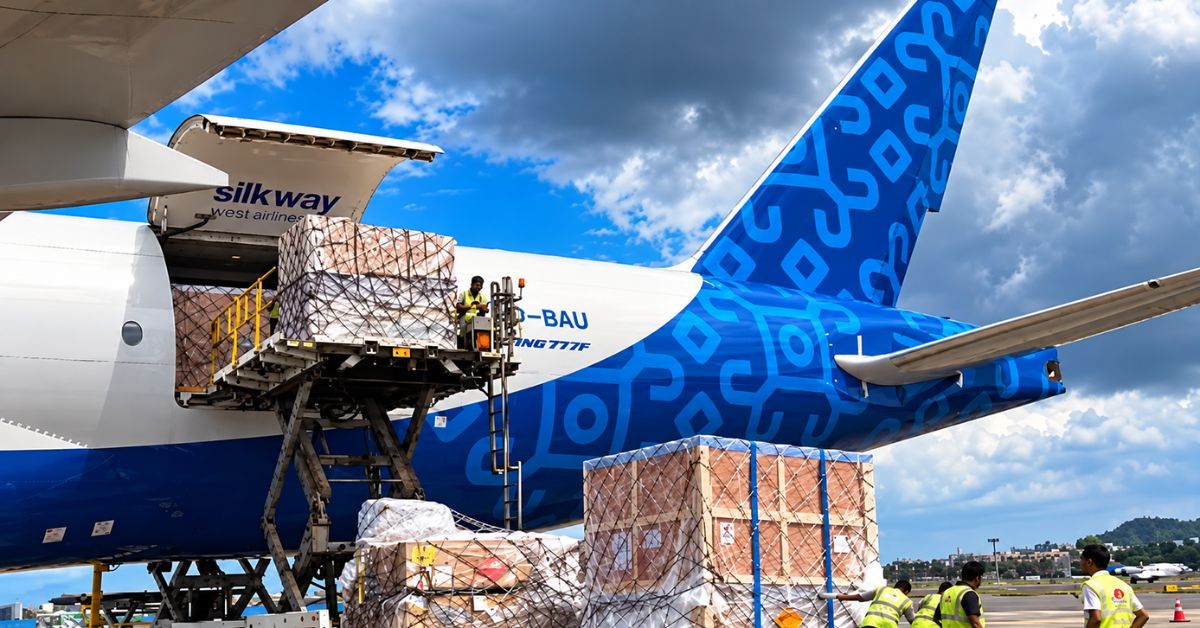
Dedicated freighter operations gained momentum in August, adding to the airport’s cargo activity. Its infrastructure has accommodated Boeing 777F and Boeing 747-8F aircraft, alongside specialised Antonov An-124 charters.
The expanding network includes international and domestic operators serving different cargo requirements. On 9 October, beyond the January–September reporting period, the airport handled eight dedicated freighters in a single day.
That operational milestone illustrates the growing range of aircraft using the facility. It does not establish a sustained daily traffic level or a comparable annual growth rate for the newly opened airport.
Cathay adds scheduled Hong Kong connectivity
An important earlier development was Cathay Cargo’s relocation of its Mumbai freighter operations to Navi Mumbai, effective 21 September 2026.
At the time of its announcement, Cathay specified three dedicated freighter flights weekly, operated with Boeing 747-400ERF and Boeing 747-8F aircraft. These services provide main-deck capacity and nose-door loading for heavy, oversized and other specialised consignments.
The Hong Kong hub connects western Indian businesses with destinations across mainland China, Southeast Asia, North America and other markets. Cathay’s cargo offering includes services for pharmaceuticals, perishables, live animals and time-sensitive commercial shipments.
The relocation concerns dedicated freighter operations. Cathay also uses belly-hold capacity on passenger services across its Indian network, providing a separate channel for cargo movement.
For exporters and freight forwarders, scheduled services provide defined capacity and connections around which shipments can be planned, complementing charter operations for particular cargo requirements.
Facilities target specialised shipments
The airport’s cargo facilities are designed to handle pharmaceuticals, perishables, oversized consignments, dangerous goods, live animals and valuable cargo.
The infrastructure includes temperature-controlled storage for pharmaceutical shipments, cold-chain facilities for perishables and secure areas for valuables. Separate storage and handling arrangements support different cargo streams, with customs facilities located within the premises.
These capabilities are relevant to manufacturers and exporters whose shipments require more than general warehouse space. Temperature management, security and specialised handling can determine which airport and airline service is suitable for a consignment.
The airport’s published development plan envisages phased expansion, with dedicated international, domestic and express cargo terminals and handling capacity increasing from 0.50 million to 2.60 million tonnes. Those figures describe infrastructure capacity and planned expansion, rather than actual cargo throughput.
FedEx investment adds a longer-term dimension
The airport’s cargo development also includes a separate FedEx project announced earlier this year.
On 18 February 2026, FedEx and Navi Mumbai International Airport broke ground on a proposed 300,000-square-foot automated air cargo hub. The project is backed by a long-term investment exceeding ₹2,500 crore and is being developed with Adani Airport Holdings.
The planned facility is intended to support consolidation and redistribution, connecting India with Southeast Asia, West Asia, Europe and the United States.
Its projected role should be separated from the airport’s current operating figures. The groundbreaking announcement describes future infrastructure, and the January–September cargo total does not demonstrate that the proposed hub is operational.
For western India’s logistics industry, the immediate development is the emergence of another operating airfreight gateway. The combination of domestic cargo, international freighter connections and specialised handling provides an initial commercial base, while future investment will determine how that base expands.
FAQs
How much cargo did the airport handle?
It handled 11,853 metric tonnes between January and September 2026.
What proportion was international freight?
International cargo accounted for 6,477 tonnes, or 54.6% of the total.
When did Cathay Cargo move its freighter operations?
The relocation took effect on 21 September 2026.
What specialised cargo can the airport handle?
Its facilities support pharmaceuticals, perishables, oversized cargo, dangerous goods, live animals and valuables.
What is the proposed FedEx hub?
A 300,000-square-foot automated cargo facility supported by a long-term investment exceeding ₹2,500 crore. Groundbreaking took place in February 2026.
 Join our WhatsApp channel for more updates:
 Subscribe to our YouTube channel for more updates:



